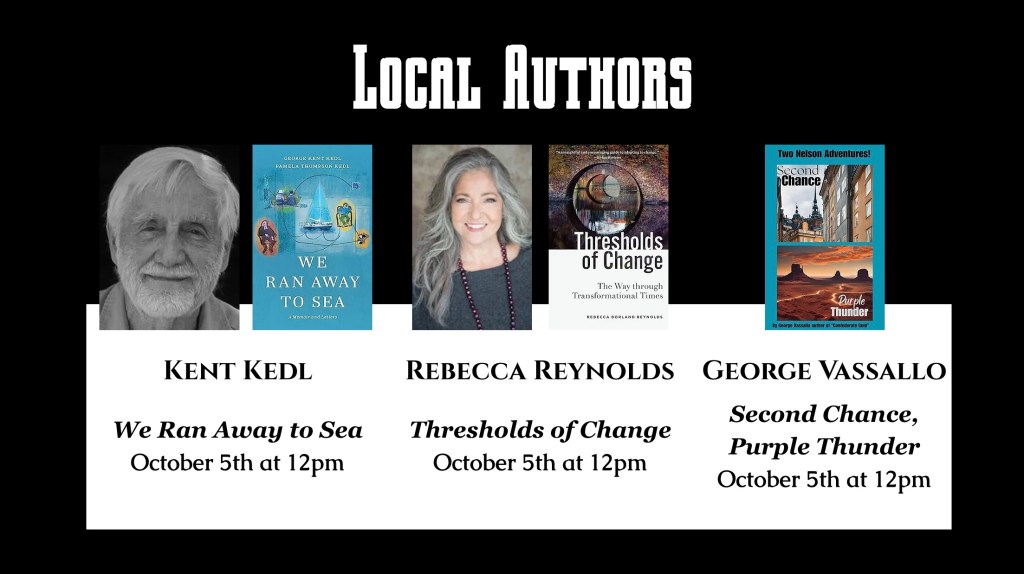
We were pleasantly surprised to learn yesterday thatWe Ran Away to Sea has been named a Finalist for the 2024 New Mexico-Arizona book awards in the category of Autobiography and Memoir. There was lots of competition to be selected as a finalist, and there will be even more for the winners, so don’t hold your breath.
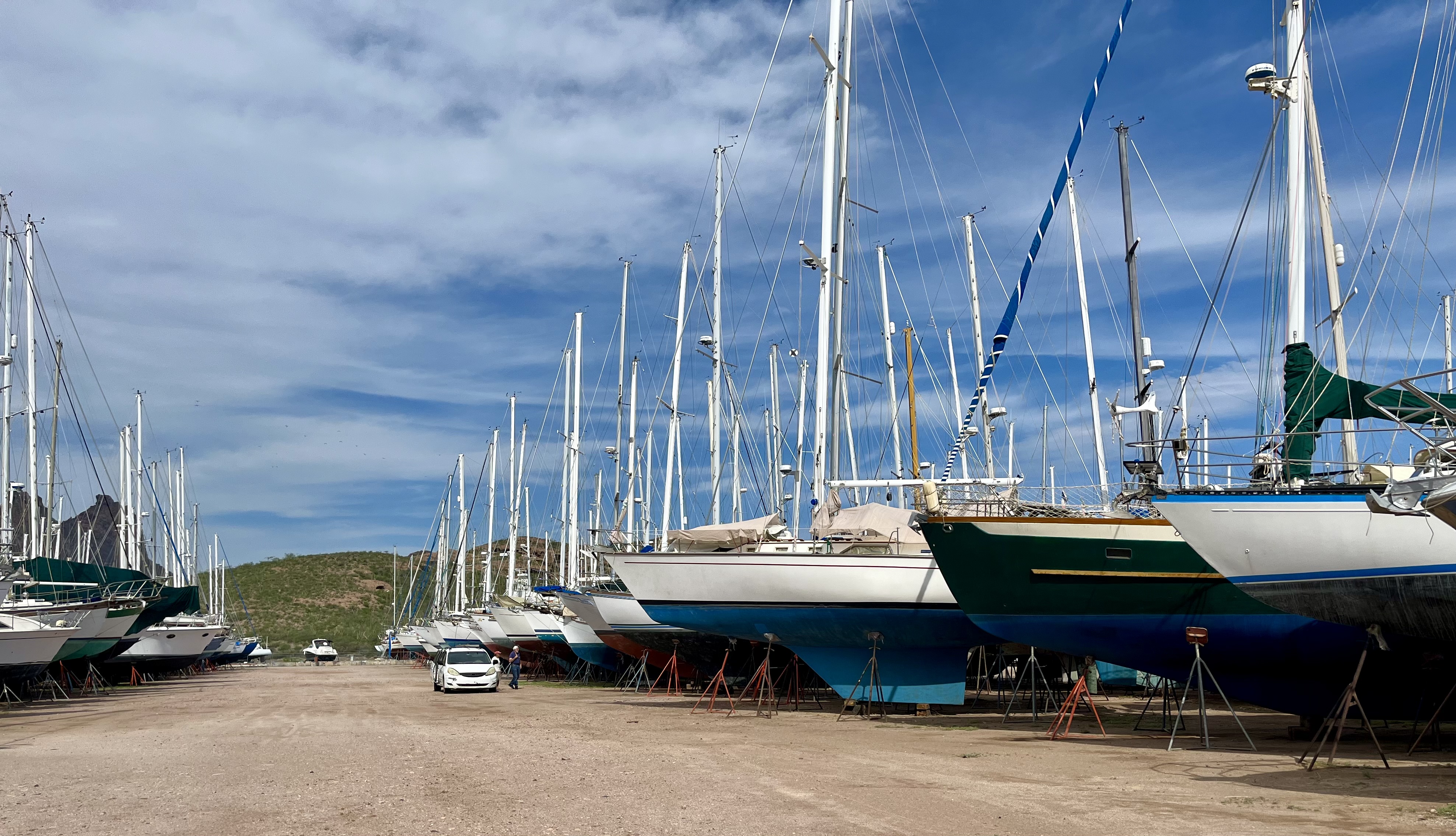
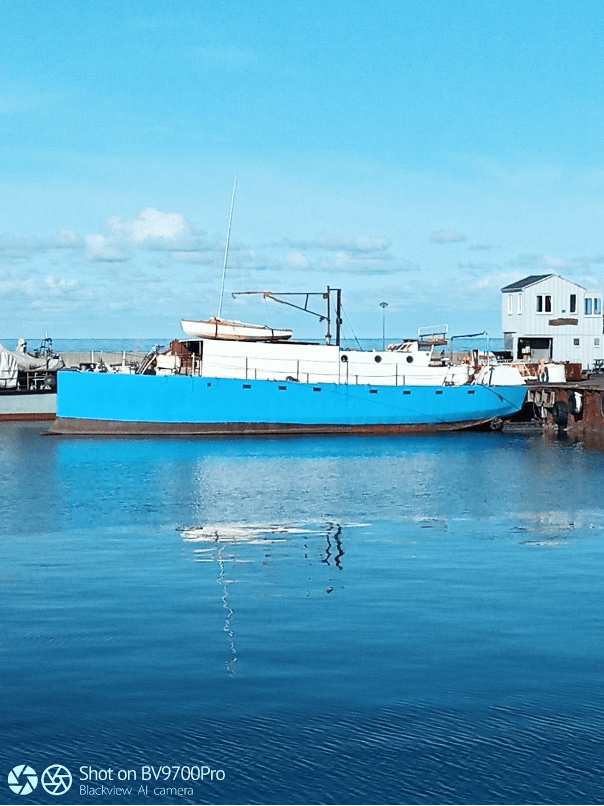
While we were in Indonesia in May, I saw a notice on my phone for a 36-foot sailboat for sale in Albuquerque for the ridiculously low asking price of $10,000. “Very odd to find an ocean-going sailboat in Albuquerque,” I thought, and out of curiosity, after we returned home, I wrote a note to the seller asking for more information. She told me that she had recently inherited the boat from her grandfather but not his sailing genes to go with it and wanted to sell it. It was an old boat built in Taiwan in 1977 and stored in San Carlos, Sonora, Mexico. She could tell me almost nothing about the boat and said to contact a fellow in San Carlos for more information. I did not know about his connection to the boat, but I wrote asking for more details. I got very little information in response, so I turned to Google and found an old for-sale notice for the boat. It had a few pictures and a partial equipment list. It had at one time been outfitted for blue-water cruising.
I began thinking I could afford it. Wouldn’t having a boat down on the Sea of Cortez, a body of water I had long dreamed of cruising, be fun? I imagined Linnea and I could make quick trips down to San Carlos, then gunk-hole up and down Baja and the mainland. We should not have to upgrade expensive equipment if we didn’t plan on extensive voyaging. So, we made a quick trip to San Carlos to take a look.
We spent a night on the way with our friend Jim in Green Valley, Arizona. Jim had a boat built in Taiwan in 1977 and sailed the Pacific for years before returning to Los Angeles and selling the boat. Then, about the time Pam, the boys, and I sailed through the Atlantic and the Caribbean, he took his wife and family on another voyage through the Pacific.
Jim and I grew up in Sheridan, Wyoming. His older brother was my high school classmate. Jim was interested in the boat, and because he was familiar with boats of that vintage built in Taiwan, I invited him to join us. He would know more about what we were looking at than I would. However, he declined because a back issue limited his walking.
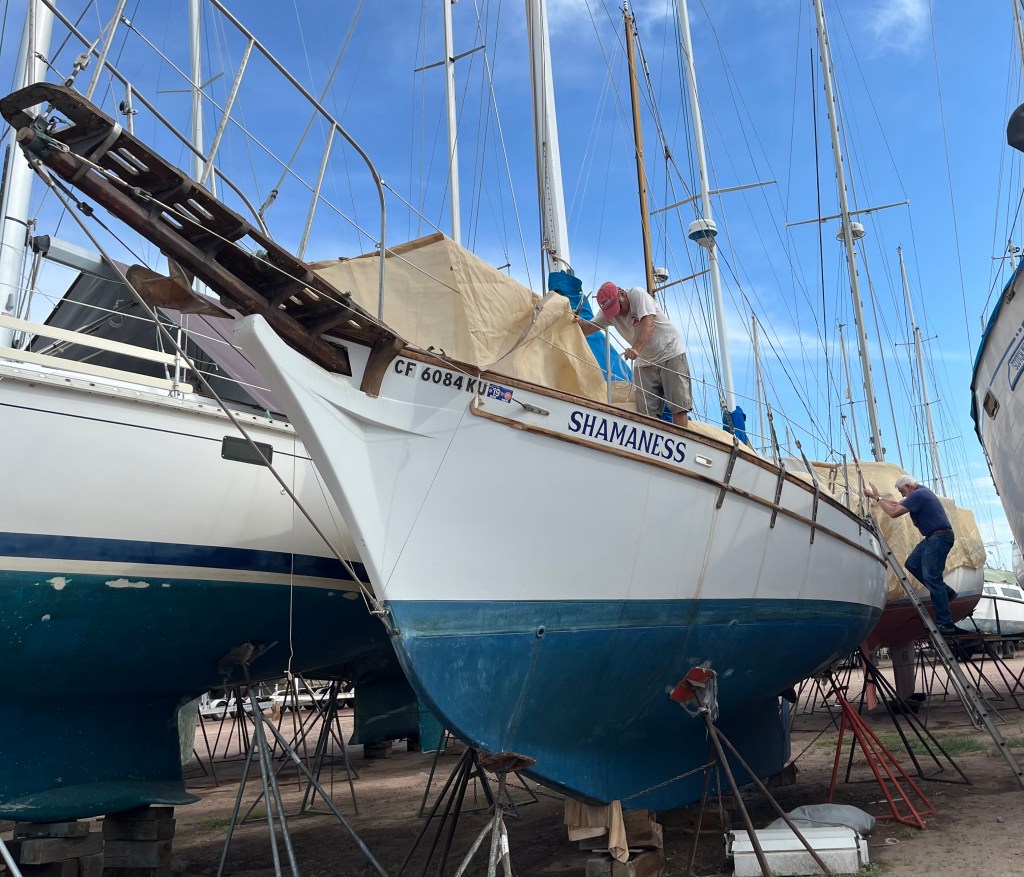
After arriving in San Carlos, I investigated the cost of storing the boat and decided it was more than I wanted to pay. The whole trip had been a fool’s errand; nevertheless, I wanted to see the boat. It seemed to be in good shape for a vessel its age and would be a bargain for a younger person willing to put in a lot of labor (and some money) to bring it up to cruising condition.
On our return trip to Albuquerque, we spent the night with Jim again, and I filled him in on what I had found. Jim had just finished filling quart bottles of his homemade rum when we arrived late afternoon. We had a pizza for dinner and sampled his rum before and after.
“Two old men and a boat would make a good story!” Linnea said, going to bed and leaving us to our boat talk. We drank another glass of rum and imagined two old men getting an old boat and fixing it up. They wouldn’t just for gunk-hole around the sea of Cortez. Oh, no! They’d spend a year or two or three sailing the Pacific. My, that was good rum.
Our talk ignited a dream I thought I had put to rest 25 years ago when Pam and I left our boat for the last time. Our talk of the boat, or perhaps it was the rum, ignited something in Jim, as well, because, after a third glass, we were no longer imaging what a good story it would make; we were talking about how we should proceed to check out the boat more thoroughly and what it would take to prepare it for voyaging in the Pacific.
Hearing about our ideas in the morning, Linnea still thought “Two Old Men and a Boat” would make a great story. Maybe Jim and I could make it happen.
Back home in Albuquerque, all I could think about was the boat and the opportunity, even at my age, to fulfill my long-held dream of sailing the Pacific. I planned to return to the boat for a thorough inspection with my new partner, Jim, who had some medical appointments and a trip planned that would postpone our trip to Mexico for a month and a half.
Yesterday morning, after a couple of weeks of not hearing from Jim, he called to tell me he could not proceed. The medical report on his back was discouraging, and while vacationing with his family, he realized he could no longer keep up.
I should not have been surprised that Jim was not up to it. Nevertheless, I was so gripped by the idea that I couldn’t drop it. Who else did I know who might be footloose and crazy enough to join me sailing the Pacific? Maybe my childhood friend, Dick, a passably healthy, active widower, might be tempted?
“Hi, Dick! Do you want to sail the Pacific with me in an old boat?” I ran out of minutes on my phone as I talked, but I could tell he was excited about getting out and doing something adventuresome. However, he’d never sailed, never had a dream of sailing, and this would probably not be an adventure he would have chosen. Nevertheless, after talking on the phone, I wrote a long e-mail laying out everything I thought would be involved and spelled out my dream.
Where was Linnea in all of this? I knew she would not, and I did not expect her to give up her active and engaged life in Albuquerque to live on a boat for a year or two. I imagined she would fly to places we visited, and we could tour them together. She might accompany us on some of the shorter passages from island to island. We’ve talked about visiting Australia together for years; that is where we’d wait out the typhoon season for several months.
I had not thought about the burden I would be dumping on her—the constant maintenance and repairs our property requires. Nor was I thinking about how my traipsing off to sail the Pacific without her would seem to her. Did I not care for her? Or for the life that we had made together? She knew that my earlier sailing dream had formed when I was anxious to escape the life I was living. Was I doing the same thing again? This morning, as we talked, I realized that I didn’t want to escape anything. I love the life I have now.
So, I wrote Dick to apologize for even bringing up my crazy idea with him—I knew this was not his thing. I was acting on the rebound from losing Jim’s partnership. I wrote to the boat owner and told her I was no longer interested in buying. As Linnea says, I don’t have to sail the Pacific to tell a story about two old men and an old boat. I could make up a good story. Maybe I will.
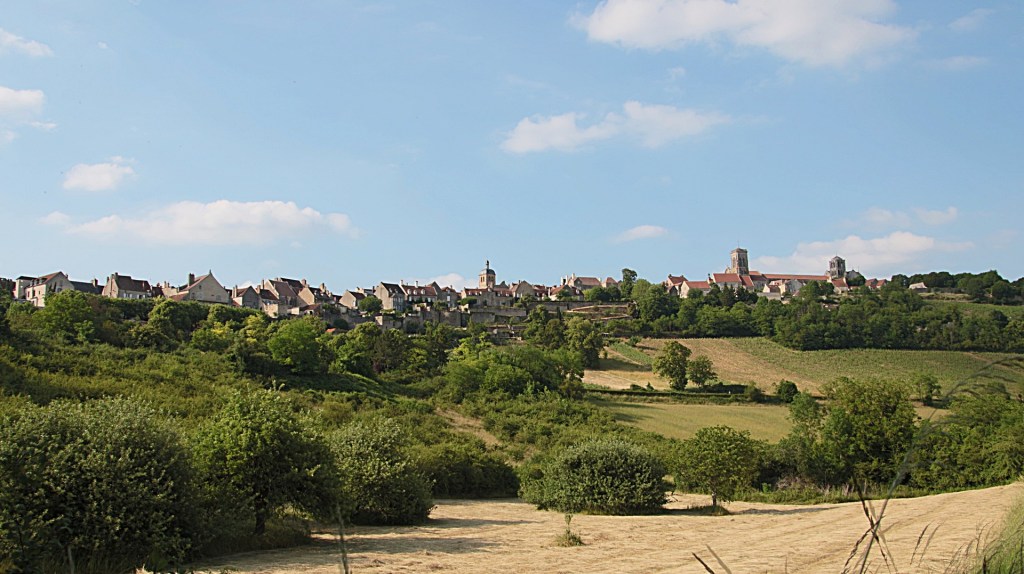
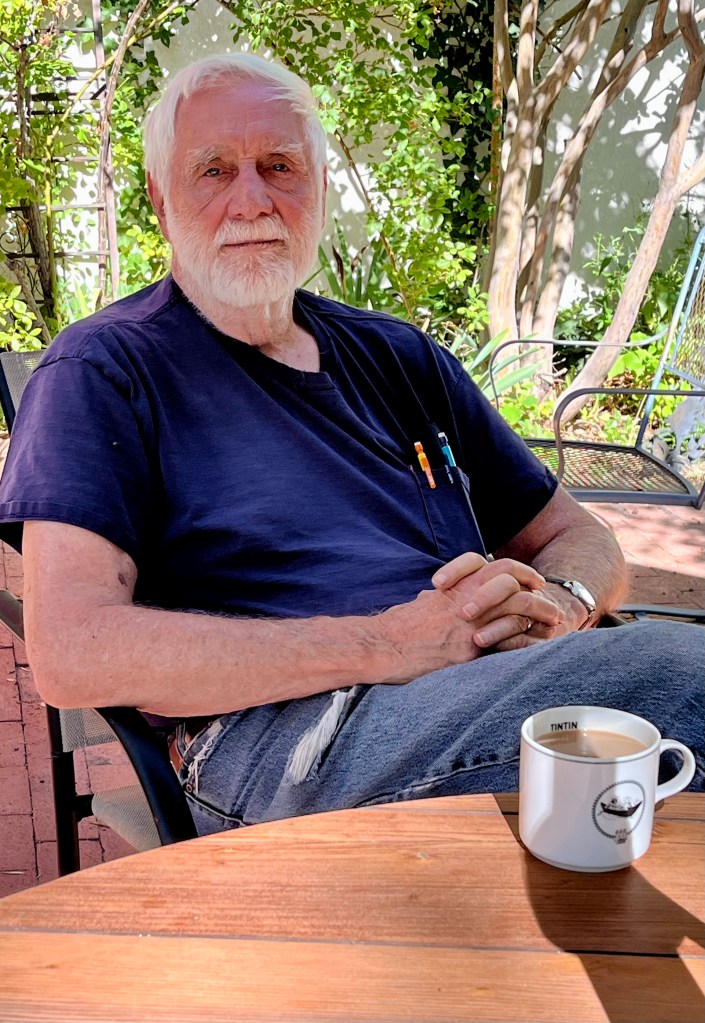
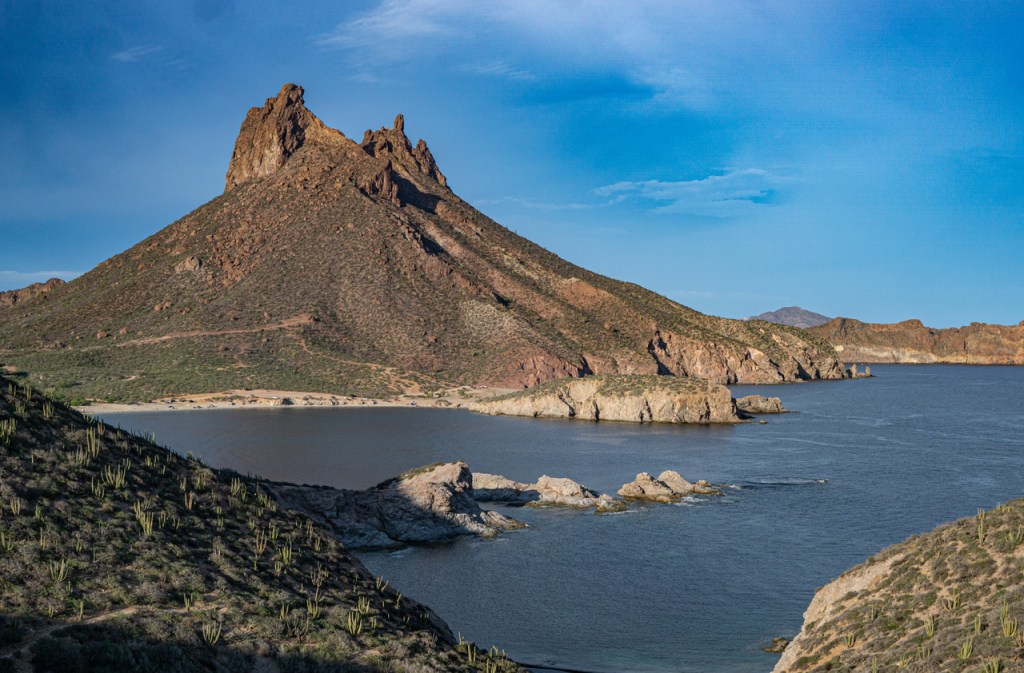
Below: Kent at home and scenes from San Carlos.
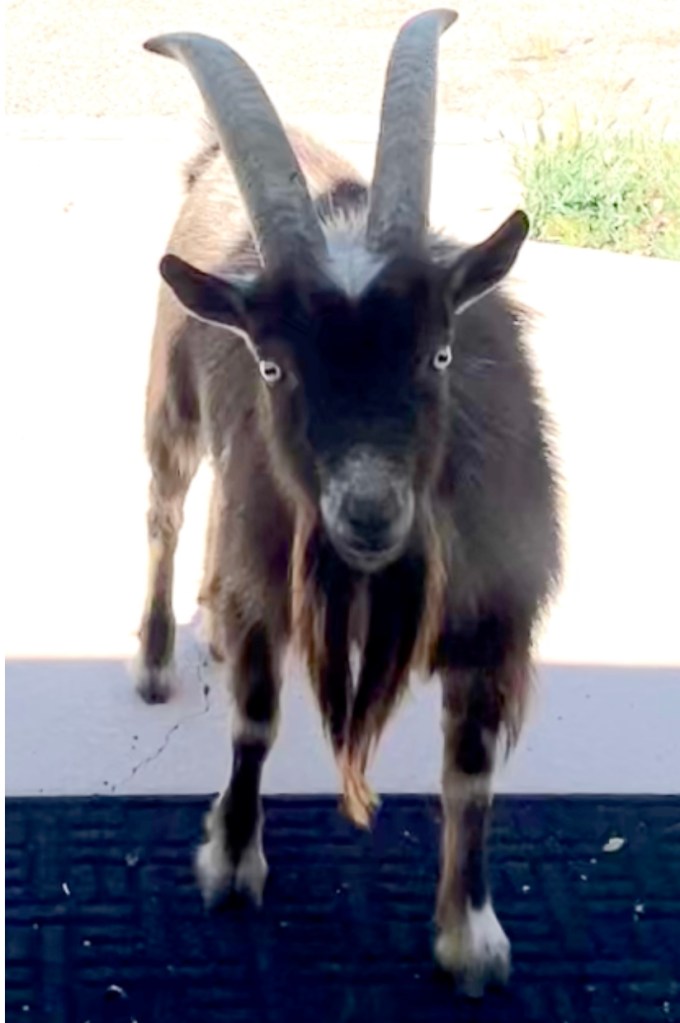
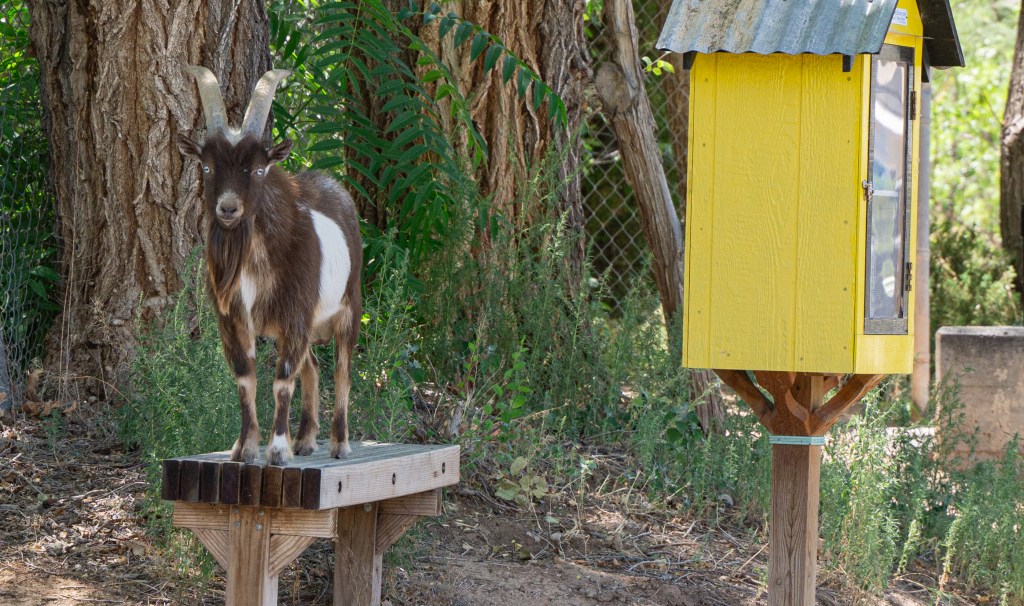
Postscript: I was about to post this when I got a call that there was a goat at our front door! I opened the door, and this is what I saw:
Goat at the door.
Kent says, “Dear, I said I want a BOAT, not a GOAT!
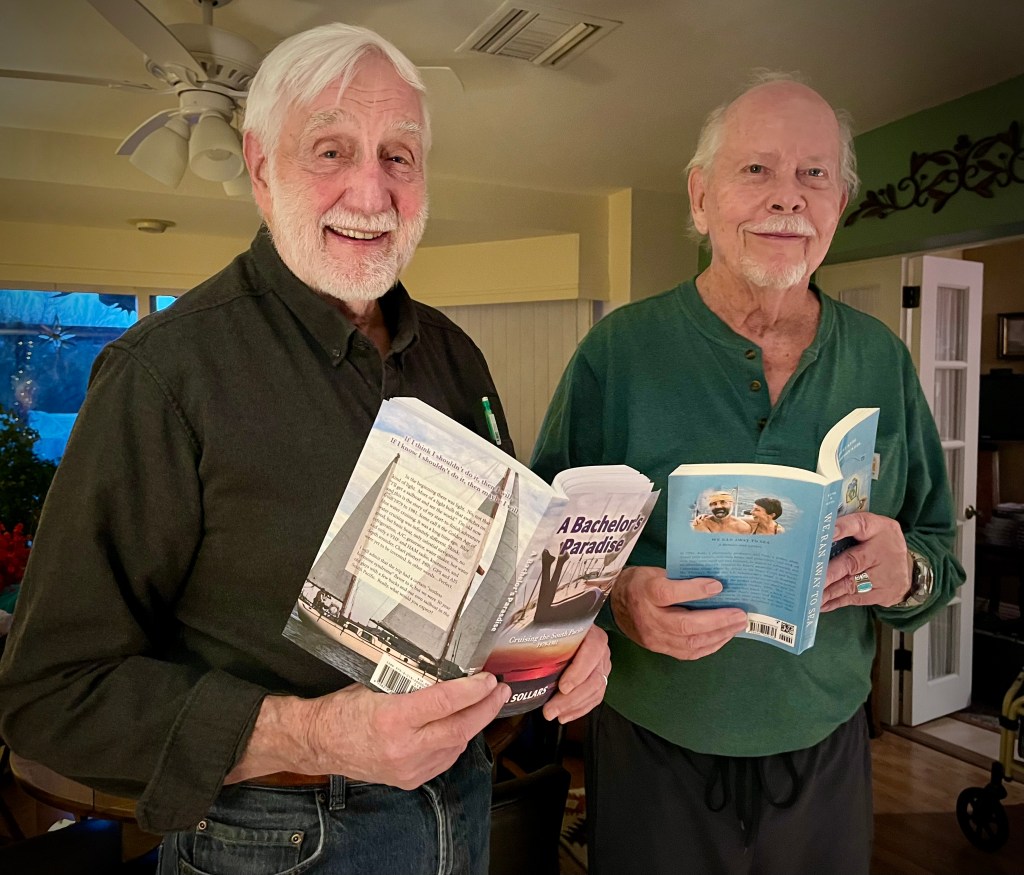
Two old sailors. Will they know when it’s time to quit?
In late July, Kent and I (Linnea) drove from Albuquerque to San Carlos, Sonora, Mexico, to see a 1977 Chung Hwa thirty-six-foot ketch listed at a bargain price.
It was a hot trip, with stops for green chile cheeseburgers at the Owl Bar in San Antonio, NM, and an overnight at the historic Palace Hotel in funky, picturesque Silver City, where Kent got a haircut and we watched karaoke at the friendly Little Toad Creek Brewery. Everybody was friendly in Silver City, including the guy who must have slept somewhere on the street.
Silver City haircut.
Palace Hotel in downtown Silver City. And we sold a book to the bookshop next door!
We bumped along bumper to bumper through downtown Nogales to cross the border into Mexico on Saturday morning. After three or four hours and a few wrong turns, we found our way to Hermosillo and San Carlos.
We had an hour to look at the boat, still filled with the belongings of the deceased owner. When Kent saw the storage fees for the Marina Seca and the amount of work the boat would probably require, he decided to forget it.
Checking out the dreamboat
We spent two days exploring what San Carlos has to offer, visiting a scenic overlook, a couple of beaches, and some funky places beyond the paved road. Our modest motel had good air conditioning and wifi and was within a fifteen-minute walk of the restaurants, shops, and bars along the marina’s waterfront.
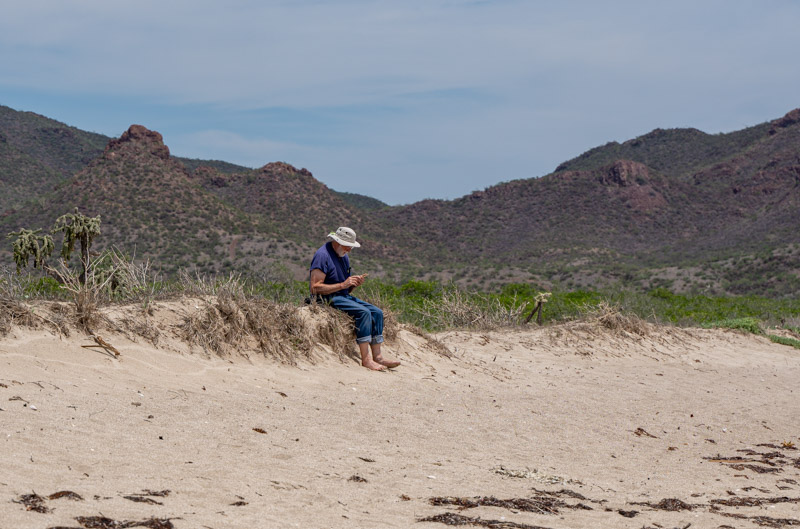
Beached sailor Kent in San Carlos, Sonora
But, when we got back to Green Valley, Arizona, after an almost two-hour wait to cross the border into the USA, Jim Sollars, another sailor and native of Sheridan, Wyoming, was excited about the boat. We’d first met Jim in February through his brother Sheldon, Kent’s high school classmate.
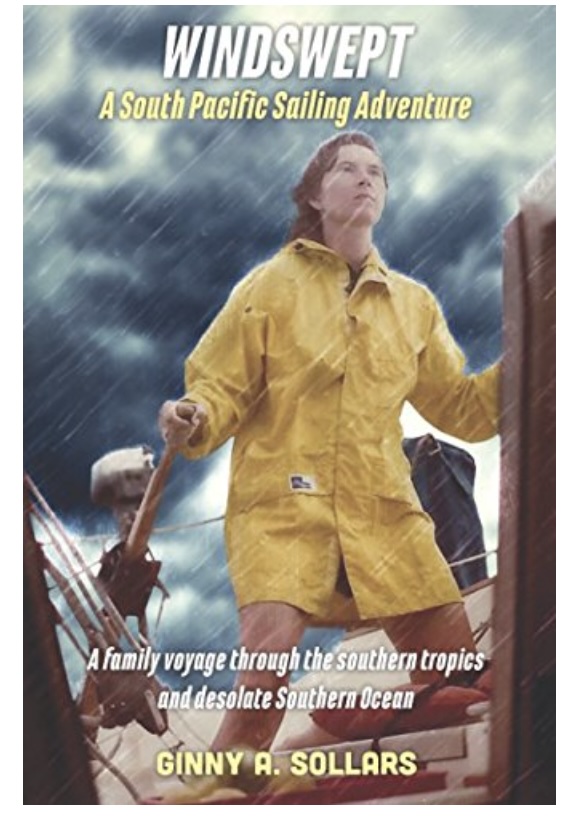
Jim had sailed the Pacific twice, once alone and once with his wife and two daughters. His late wife, Ginny, published Windswept, the story of the family’s three years aboard their boat, Holokiki. Jim more recently published A Bachelor’s Paradise, filled with wild tales of his years as a young, single sailor.
After pizza for dinner, Jim and Kent stayed up late, drinking homemade rum, telling stories, and convincing themselves that two old men could take off into the Pacific on an almost fifty-year-old boat that may need considerable work.
“It would make a good story, anyway,” I said as I headed to bed with a good book, leaving the octogenarians to their plans and dreams.
“Maybe I’ll meet you in Puerto Vallarta, Hawaii, or Fiji.”
Kent has an appointment with the Neptune Society this week.
“Ask them,” I said. “If your body is lost at sea, will you get your money back?”
In April, we quoted Pam writing about the dinghy under the bed, when she was dreaming of taking off to sea again and leaving the South Dakota winter behind.
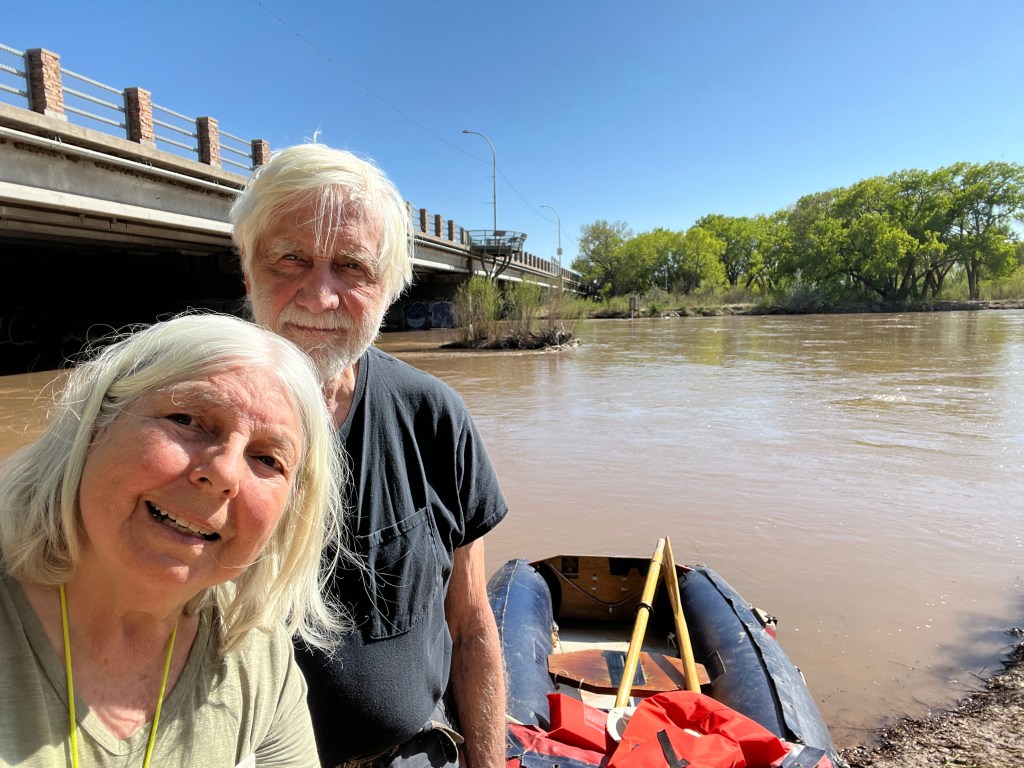
At the end of April, we finally got the old dinghy out on the Rio Grande. Getting it from the back of the car and carrying it to the water and out again was the hard part. Our trip was rather short at about 45 minutes from launch to take-out, but we did it! Paddling down the Rio Grande, we’d never know we were in the midst of a city of over 500,000. It was a little taste of life on the water. Then we went to San Francisco where waves rolled in from the Pacific. I made a short video, hoping whet (wet?) your interest.
We’ve recently had some lovely responses to We Ran Away to Sea. Geoff Boerne, the captain of Lo Entropy, a boat Kent and Pam encountered in Mexico in the 1990s, last week finally received the copy of the book we’d sent him at the end of February. Apparently it takes a long time to get a book to Denmark! He tells us he started reading on Friday evening and finished the book on Saturday afternoon, sad to have it come to an end. He also saw the book as not just a sailing book, but a love story, which I, too, think it is. He had much more to say, and, of course, identified with all the sailing bits. Thank you, Geoff!
There is more about Geoff and his current endeavors in today’s blog post. Check out what he and Peter Roberts are doing to help save our planet, by clicking the following link on my Caminobleu blog:
Kent will be giving a book talk: Saturday, June 29 from 1-2 p.m at the Juan Tabo branch of the Albuquerque Public Library.
He will also be selling and signing books with a few other authors on Saturday, July 6 at the lovely Garcia Street Books, Santa Fe, from 10-12 am. We hope to see some of our Santa Fe friends!
Three copies of the book are now available at the Albuquerque Public Library, and there is a waiting list! The call number is 813.54 KEDL. Please request more copies!
We Still Need More Reviews
Check out the new reviews on Amazon and on our webpage: Follow Kent’s author page by clicking on follow on Amazon. We need more reviews! Good Reads is another place to put reviews. Can you help us get up to 50? We’re almost there! See the help on posting reviews a bit farther down the page.
There was a sudden spike in book sales in early June for three days in a row. That was a welcome mystery, and we hope it keeps up.
I also added some new content to the book page on Amazon. But, oops! Only part of the content appears on the paperback page. It’s all there on the Kindle page, so look there for now, and I’ll try to fix it tomorrow.
Send us a picture of you reading the book
Please send us your picture of you or someone reading the book or seeing the book in interesting places.
Esther Jantzen, author of Walk: Jamie Bacon’s Secret MIssion on the Camino de Santiago, and founder of Elder Activist Readers, enjoying We Ran Away to Sea.
Return from Indonesia
We took a break from book stuff for three weeks in May and enjoyed a fascinating impromptu trip to Indonesia. We were so captivated by our experiences that we totally forgot to take pictures with the book in the many intriguing and scenic places we visited. Alas! But here we are, without the book!
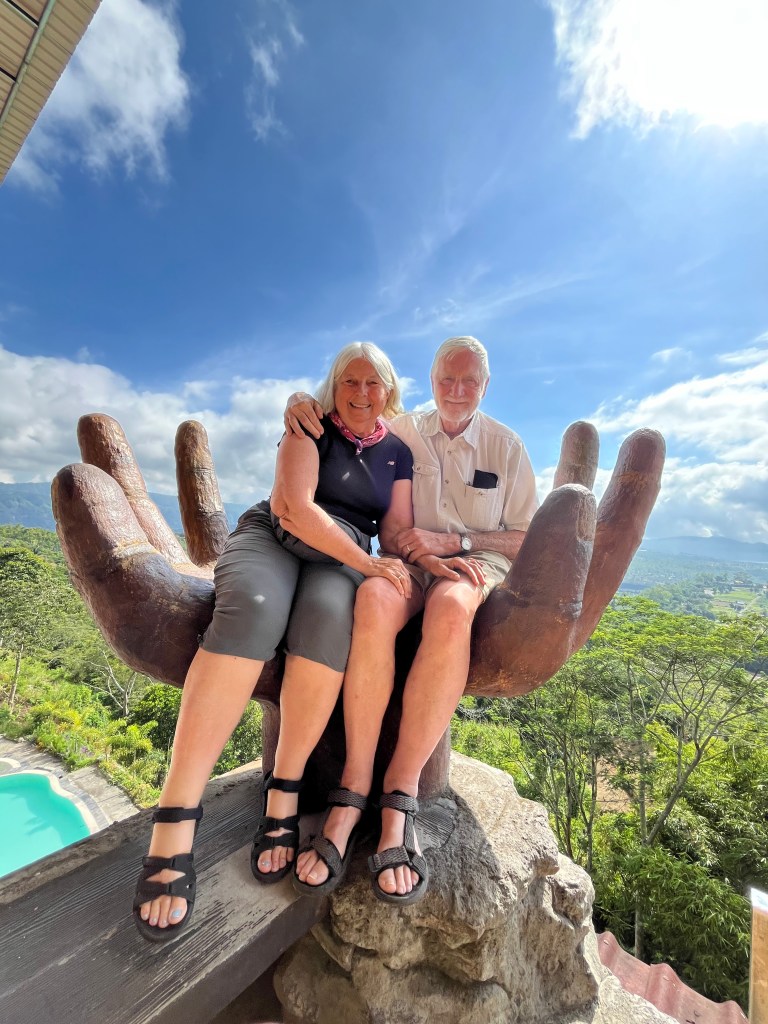
Linnea and Kent riding high in the sky in Bali, Indonesia
Rio Grande from Central Avenue Bridge, Albuquerque
If you have read We Ran Away to Sea, you know that Pam and Kent ran away partly because they were concerned about the environmental impact of America’s consumer-driven lifestyle.
Elder Activist Readers (EAR)
More recently, Kent and I have participated in book discussions in a small group we call EAR (Elder Activist Readers), spearheaded by Esther Jantzen, the author of the children’s novel Walk: Jamie Bacon’s Secret Mission on the Camino de Santiago. Esther, like me, was inspired by her experiences as a pilgrim. Over the past three years, our little reading group has read eighteen books and become more knowledgeable about the environmental threats to our planet. We’ve also studied the history of our current crisis and have taken small steps to support people and organizations working on solutions.
Geoff Boerne
Pam and Kent encountered Geoff Boerne’s Lo Entropy in Mexico in the 1990s. Sailed by two young Brits, Ian and Alan, the ship seemed to be in dire straits the last time Pam and Kent saw her. Kent concluded his Lo Entropy story, “I would like to think Alan made a go of his venture in the end, but it certainly looked like Lo Entropy had run out of energy.”
So, what did happen to her? I discovered a film on YouTube, The Cuba Connection by Claudio von Planta, telling the story of the ship before Pam and Kent met her. Lo Entropy was constructed mainly of recycled materials, although most of the steel had to be purchased new. Her first mission was a partly successful attempt to deliver donated supplies to Cuba, where people were suffering from the impact of the United States boycotts.
I discovered a website authored by Geoff Boerne, the majority shareholder and Managing Director of Celtic Cruises Ltd., whose only asset is Lo Entropy. Geoff and another unpaid director, Nick Rodgers, are endeavoring to keep Lo Entropy afloat as a wind and hydrogen-powered transport vessel.
According to the Transport Environment website, shipping produces at least three percent of the transport industry’s carbon. Googling “sailing and hydrogen” reveals numerous websites and articles about recent efforts to create “zero energy” shipping. In 2022, Geoff Boerne published “A Milestone for Sail Cargo Pilot Project: Goal and Hydrogen Concept.” Cruise and transport companies such as Norway’s Hurtigruten (which plans to launch an energy-efficient cruise ship by 2030) are looking into zero-energy transport. A return to sailing ships, assisted by green technology, is a promising alternative to diesel fuels. Maybe in the future, we will all, like Greta Thunberg, be crossing the oceans under wind power.
Geoff wrote to me, “Lo Entropy’s sails are currently assisted by an electric motor that doubles as a powerful generator when the propeller is free-spinning or driven by the diesel engine. We hope to replace the diesel engine with a hydrogen-fueled (ICE) internal combustion engine. Times are changing. Toyota has now produced a hydrogen combustion engine, so we are considering eliminating the expensive fuel cell and using hydrogen to fuel a hydrogen combustion engine.”
A hydrogen system combined with wind and solar will produce energy for a two-hour capacity battery bank that will convert the excess energy to hydrogen and store it for propulsion when needed. Geoff is seeking investors to help refit the vessel. He now lives in Denmark and can be contacted through his website https://www.greenseatransport.com/ or his email address, Loentropy@gmail.com)
Lo Entropy, 2024
Peter Roberts
Peter met with EAR on February 29, 2024, to tell us about his work and its place in the future of green building. Peter has two web pages, and some wonderful videos have been made about his work. He recently completed his model masonry house, which is now available to rent through VRBO and Airbnb. Peter also holds several patents.
Peter Roberts’ house in Alfred, New York
He gave a fascinating overview of what he sees as problems and possible solutions to the considerable amount of carbon produced by the construction industry. He told us that cement is one of the most commonly used materials on earth. Second only to water. The construction industry, which amounts to about four trillion dollars worldwide, is conservative and slow to change. However, there are new ways of making cement, using materials other than the traditional limestone and clay that are mined, ground to a fine powder, and then heated at very high temperatures. Peter explained many of the new techniques, including using volcanic material as the ancient Romans did to make constructions that are still standing after two thousand years. I confess that until I listened to Peter, I didn’t know that cement and concrete were two different things, even though we often use them interchangeably in everyday language. Cement is the binding ingredient that is essential in making concrete. There is much information available on all of this. A good starting place might be:
Learning about the work of Geoff Boerne and Peter Roberts gives me hope for a more sustainable future for our planet. Please contact either of them if you would like more information or are interested in helping with their endeavors. Perhaps one day we’ll have zero carbon emission and create concrete boats propelled by wind and hydrogen?
18) Thomas Hübl, Attuned: Practicing Interdependence to Heal Our Trauma—and Our World, pub 2023 (read Feb-Mar 2024)
17) Deb Chachra: How Infrastructure Works: Inside the Systems That Shape Our World, pub 2023 (read Jan 2024)
16) Edward Struzik, Swamplands: Tundra Beavers, Quaking Bogs, and the Improbable World of Peat, pub 2021 (read Oct 2023)
15) Joy Harjo, Poet Warrior: A Memoir(poet laureate) read ???
14) Sarah Augustine, The Land Is Not Empty, pub 2021 (read Jun 2023)
13) Amitav Ghosh, The Nutmeg’s Curse, pub 2022 (read Mar 2023)
12) E.F. Schumaker, Small Is Beautiful, pub 1973 (read Dec 2022)
11) Vanessa Machado de Oliveira, Hospicing Modernity: Facing Humanity’s Wrongs and the Implications for Social Activism, pub 2021 (read Oct 22)
10) Imbolo Mbue, How Beautiful We Were, pub 2021 (read Aug 2022)
9) Robin Wall Kimmerer, Braiding Sweetgrass,pub 2013 (June 2022)
8) Kristen Olsen, The Soil Will Save Us, pub 2014 (read Apr/May 2022)
7) Paul Hawken, Regeneration: Ending the Climate Crisis in One Generation,pub 2021 (read Feb/Mar 2022)
6) Lydia Millet, A Children’s Bible, pub 2020—a novel (read Jan 2022)
5) asknature.org website —created by Janine Benyus, Biomimicry Institute (studied Oct 2021)
4) Kate Haworth, Doughnut Economics: Seven Ways to Think Like a 21st Century Economist, pub 2017 (read Jul/Aug 2021)
3) Arlie Hochschild, Strangers in Their Own Land: Anger and Mourning on the American Right, pub 2016 (read June 2021)
2) Shalanda H. Baker’s Revolutionary Power: An Activist’s Guide to the Energy Transition,pub 2021 (read Mar-Apr 2021)
1) Ayana Elizabeth Johnson and Katharine K Wilkerson (eds), All We Can Save: Truth, Courage, and Solutions for the Climate Crisis, pub 2020 (read Jan 2021)
Also, we’ve reviewed some articles and digital resources, including:
Jeremy Lent—Patterns of Meaning (Mar 2022) blog piece on climate change and capitalism NMHealthySoil.org New York Times article on chicken Kiss the Ground (video)
Despite my efforts to be creative in promoting the book, I have been discontented these past months with the modest sales of We Ran Away to Sea. I recently contracted someone in Poland to analyze my efforts with Amazon ads, upon which I’ve been spending an inordinate amount of time and money with mediocre results. I enjoy the creative aspects of promotion, but not the nitty-gritty details or keeping track.
This morning, a serendipitous detour led to some unexpected pleasures as I reflected upon “Now is the winter of our discontent, made glorious summer by our sun of York,” the brilliant opening lines of Shakespeare’s Richard III. The link below provides an excellent analysis of the entire passage and concludes with a fabulous video of Laurence Olivier delivering the soliloquy.
My Polish mentor suggested that the blurb which I revised several times with the dubious “help” of ChatGPT was more a synopsis than an invitation to read the book. So, I tackled revising the blurb, and I invite your suggestions and comments. I uploaded the revised blurb for both the ebook and the paperback onto Amazon last night, but I’m not satisfied with either. This morning, I wrote the following shortened version with no use of AI.
So, channeling Shakespeare again, Ladies and Gentlemen, please “lend me your ears” (Julius Caesar) and your advice.
(1) Revision March 22 (morning)
Frustrated and unhappy with their comfortable lives in mid-America, Kent and Pam sell the family home and all their possessions and run away to live on a sailboat. With no experience of the sea or sailing, they fly to England with their children in search of an affordable boat. Their first sail is across the Atlantic. In the days before GPS, they rely on celestial navigation to get them to the Caribbean. Are they crazy, brave, foolish, or all three? Would you or wouldn’t you do what they did? Told in two voices from different perspectives, Pam and Kent’s accounts of their lives at sea and at home will give you much to think about.
Run away with Pam and Kent and explore the unknown with them and within yourself.
Or should the opening (continuing the Shakespeare allusion) be: “Discontented with their comfortable lives…”?
(2) Current Kindle version (as of March 22)
Would you voluntarily give up your secure, comfortable life for the unknown?
When Pam and Kent make the audacious decision to sell their house and everything in it and embrace life at sea, they envision a harmonious existence on their sailboat, filled with adventure and togetherness. However, their dreams shatter early on when Pam and the children abandon Kent and their boat in Europe, leaving him disheartened and adrift. Undeterred, he embarks on a solitary journey through the equinoctial gales of the Bay of Biscay, accompanied by a hired crew. Weeks later, Pam has a change of heart and joins him with their ten-year-old son in the Canary Islands for the Atlantic crossing. Using celestial navigation in the days before GPS, they arrive in Antigua as planned. But little do they know that the challenges of their chosen new life are just beginning.
Pam’s vivid letters and Kent’s heartfelt stories document the grand experiment of their years at sea, their risky overland travels, and the struggles that threaten to pull them apart but bring them closer together. The book contains maps, photos, a timeline, and a glossary.
(3) Current Amazon paperback version (as of March 22)
Would you voluntarily relinquish your comfortable life and worldly goods and set out for the unknown?
When Pam and Kent decide to sell their house and embrace a life at sea, they envision a harmonious existence on their sailboat, filled with adventure and togetherness. However, their dreams shatter when Pam and the children abandon Kent and their boat in Europe, leaving him disheartened and adrift. Undeterred, he embarks on a solitary journey through the equinoctial gales of the Bay of Biscay, accompanied by a hired crew. Weeks later, Pam has a change of heart and she and ten-year-old Andy join him in the Canary Islands for the Atlantic crossing. Using celestial navigation in those days before GPS, they reach the Caribbean. Yet, their challenges are just beginning.
Although Kent yearns to sail through the Panama Canal and explore the vast Pacific, Pam harbors deep-seated fears, and fourteen-year-old Jake, who has reluctantly joined them in the Virgin Islands, craves the familiarity of friends back home. Despite memorable family adventures, Kent reluctantly relinquishes his cherished dream.
Nearly a decade later, Pam and Kent sell their home and possessions again, this time venturing through the Great Lakes into the North Atlantic, through the Bahamas to the Caribbean. For over six years, they travel to offbeat destinations and undertake daring overland journeys through Central America, Venezuela, and Colombia—a country then known for its perilous reputation. Kent remains steadfast in his desire to traverse the Panama Canal and sail the Pacific, but equipment failures, storms, illness, financial worries, and family complications often interrupt their idyllic moments.
Will Pam succumb to her fears, or will Kent embark on his grand voyage alone? Share their journey and the difficult, sometimes heart-wrenching decisions involved in living at sea.
So that’s it! Which of these versions or variations of them would entice you to read the book? What would Shakespeare write? Comments?
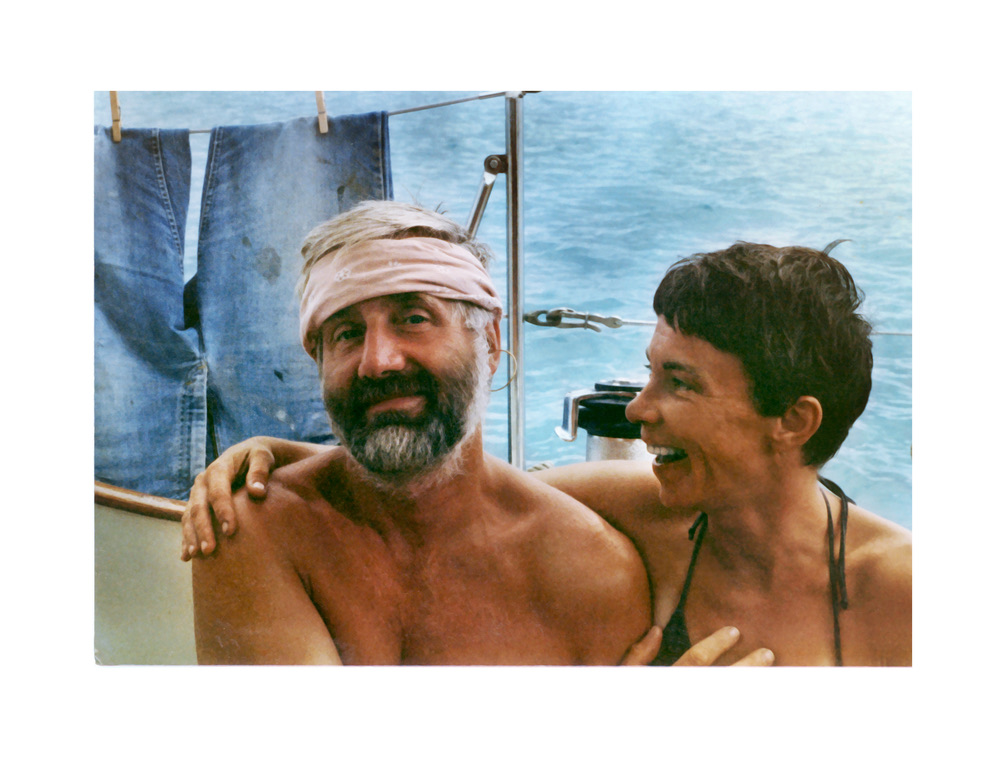
Near the beginning of We Ran Away to Sea, Pam leaves Kent and the boat, taking the two boys and fleeing back to familiar Brookings, South Dakota. He is not sure whether she will ever come back. She does, but not for the long-term that he envisions. The tension between Kent’s dreams and Pam’s, between their love for each other and their different goals and perspectives is the essence of We Ran Away to Sea. Uniquely written in two voices, the reader experiences the struggles and the rewards of their love for each other and their determination to stay together despite their differences.
As Thomas Hübl writes in Attuned, “We could think of marriage as a process of learning and becoming aware of everything we missed about our spouse when we first fell in love.” (84)
I attempted to capture the essence of this struggle in the very short video, Pamela or Panama?
Welcome to 2024! We are home from our six weeks in Scandinavia, Finland, Estonia, and Latvia, finishing with two days each in Berlin and Amsterdam. We met wonderful people (many helped us when we were lost, which happened a lot!), spent Christmas with families in Sweden, and enjoyed time on boats, trains, and buses. We loved the beautiful snow and endured some rain, dark days, icy walking, and record-breaking low temperatures.
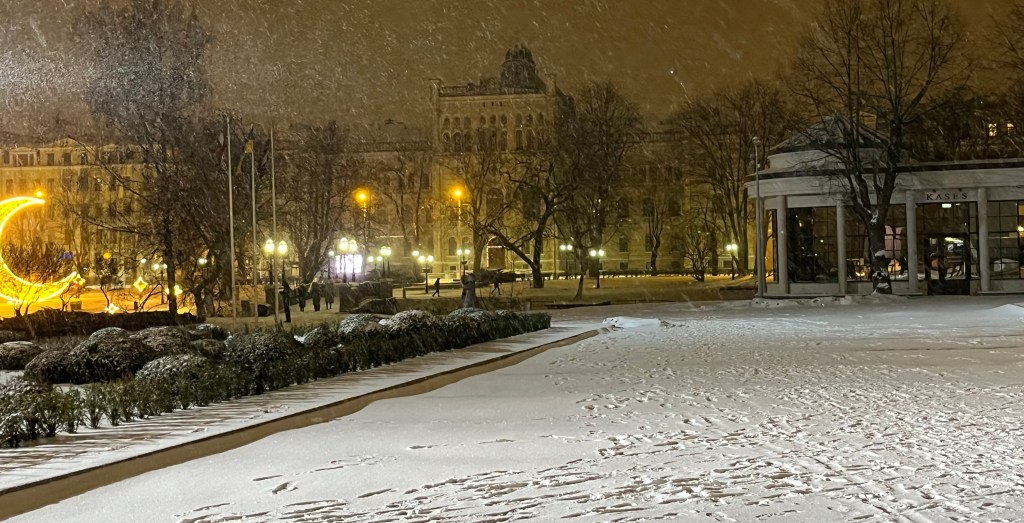
Snowy night outside of the opera house in Riga, Latvia
Our “seat of the pants” travel had some surprises. The weather was record-breaking cold by the time we reached Tallinn, Estonia, which was beautiful in the snow with the Christmas market still going in full swing when we arrived on New Year’s Day. But, we soon realized we weren’t going to have time to see all the Baltic countries and make our way through Poland and Germany to Amsterdam unless we traveled nonstop, so we found a patient travel agent in Tallinn, who booked airline tickets from Riga, Latvia to Berlin for us.
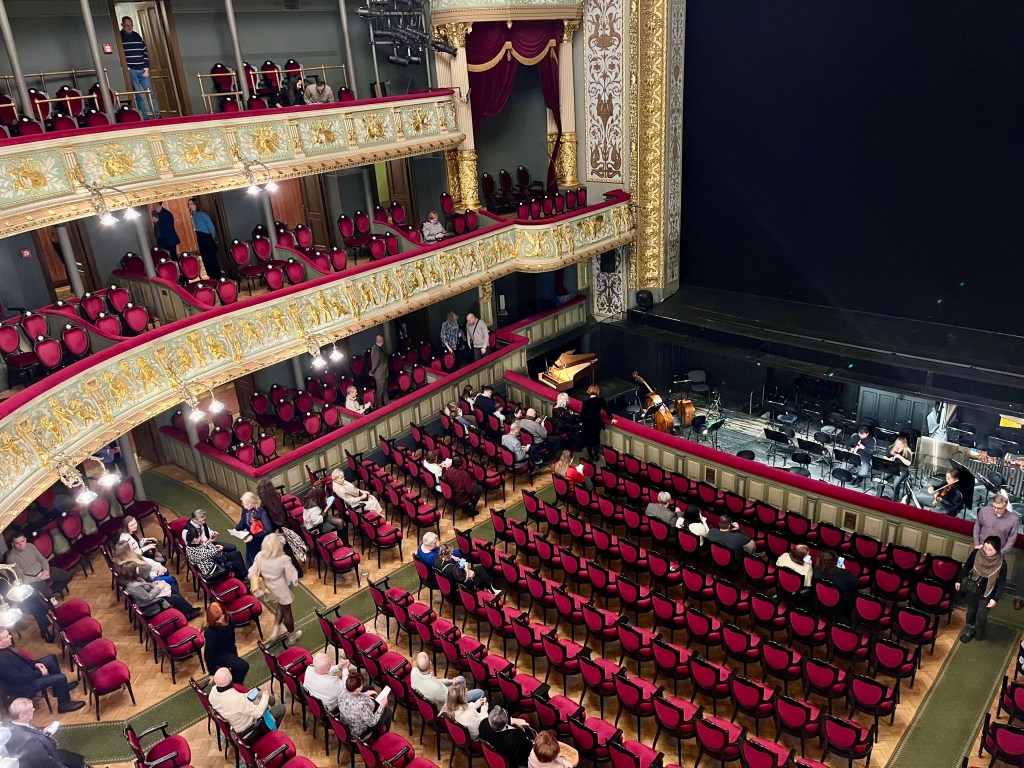
We took a bus to Riga where we stayed in a hotel near the Latvia National Opera house. We had heard that the Latvia Opera was outstanding, and we were fortunate to get tickets to a stunning performance of Mozart’s Don Giovanni. We left snowy Riga before the first light in the continuing all-night snowfall. In Berlin, we rode buses and trams and visited two outstanding museums that were free on the first Sunday of the month.
Inside the Latvia National Opera House
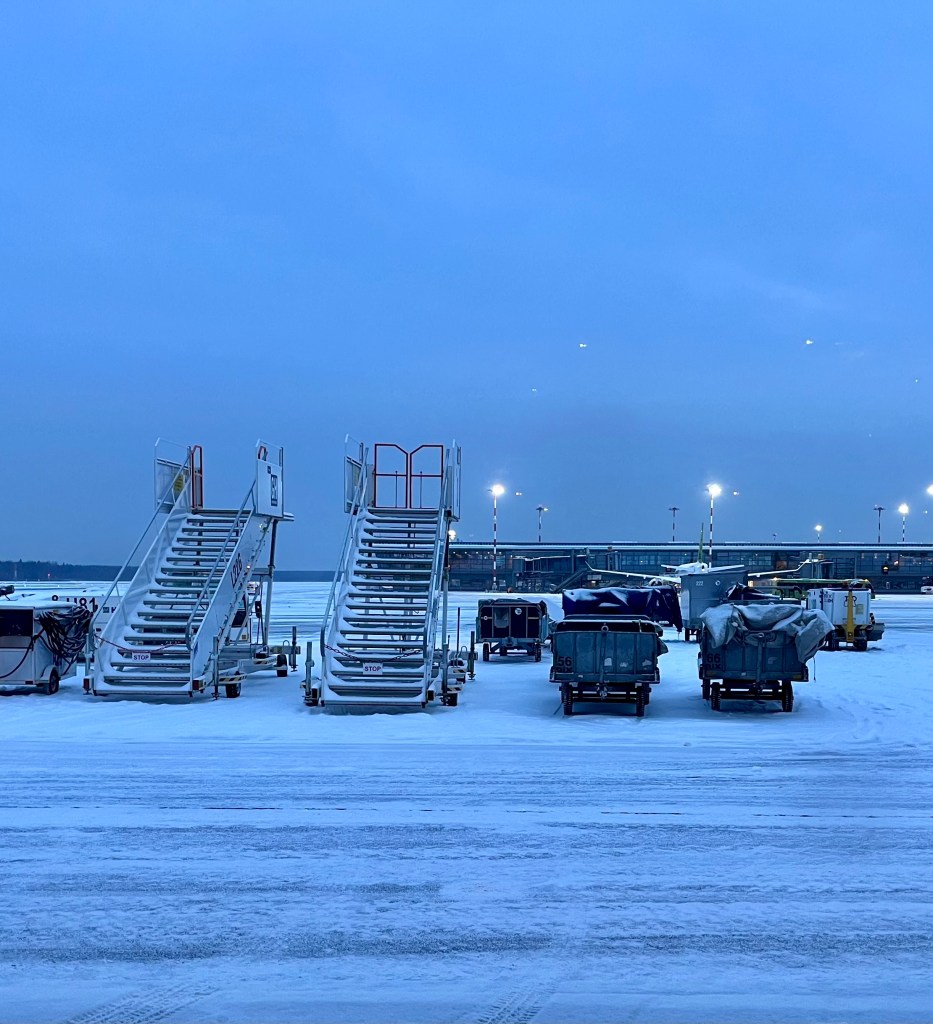
Stairs to nowhere, at the Riga airport
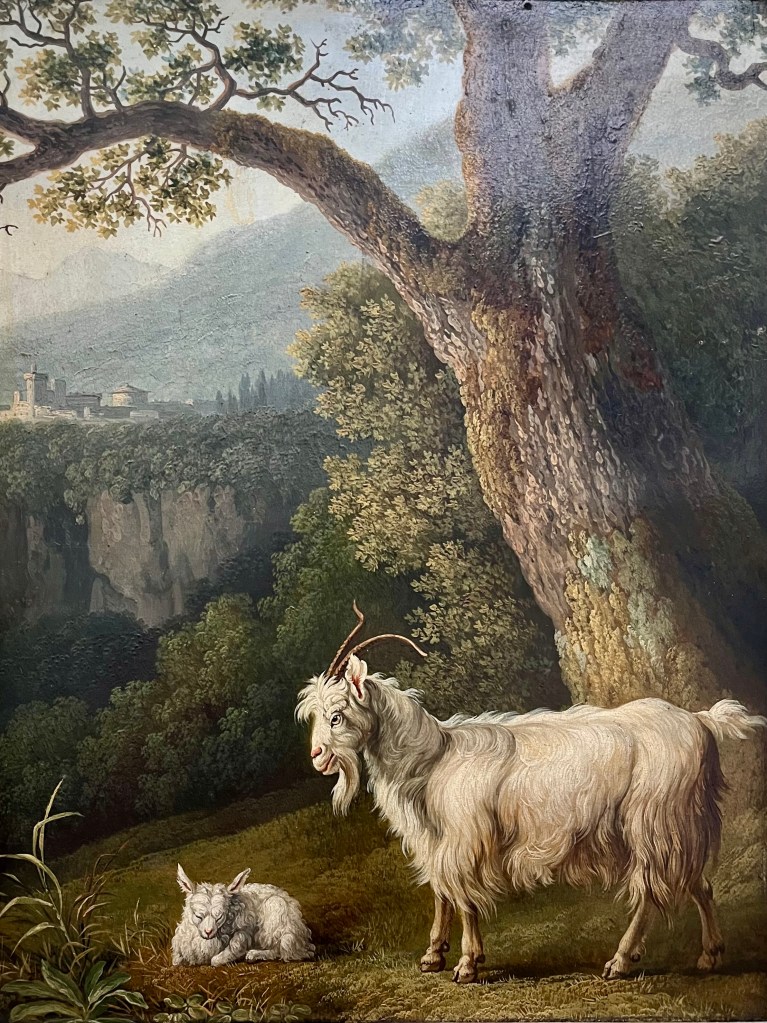
Enchanting pastoral scene by Jacob Philipp Hackert (1737-1807) in the Alte Nationalgalerie, Berlin
Berlin Hauptbahnhof (central train staion)
First view of Amsterdam, looking back toward the train station
We took the train to Amsterdam, where we stayed in a lovely, quirky old canal house hotel with stairs that were almost like climbing a ladder. We spent an entire day in the Rijksmuseum, where I loved watching the docents working with school children. One energetic young man had the children so excited by the details he pointed out in Rembrandt’s “Night Watch” that they stood up, crowding around him to get a better look. Even though I didn’t understand Dutch, I, too, discovered details I’d never noticed before.
Home at last, we’re plunged into taking care of things ignored for six weeks, connecting with friends and family, and working on Kent’s Oasis talk, which is going to be brilliant!
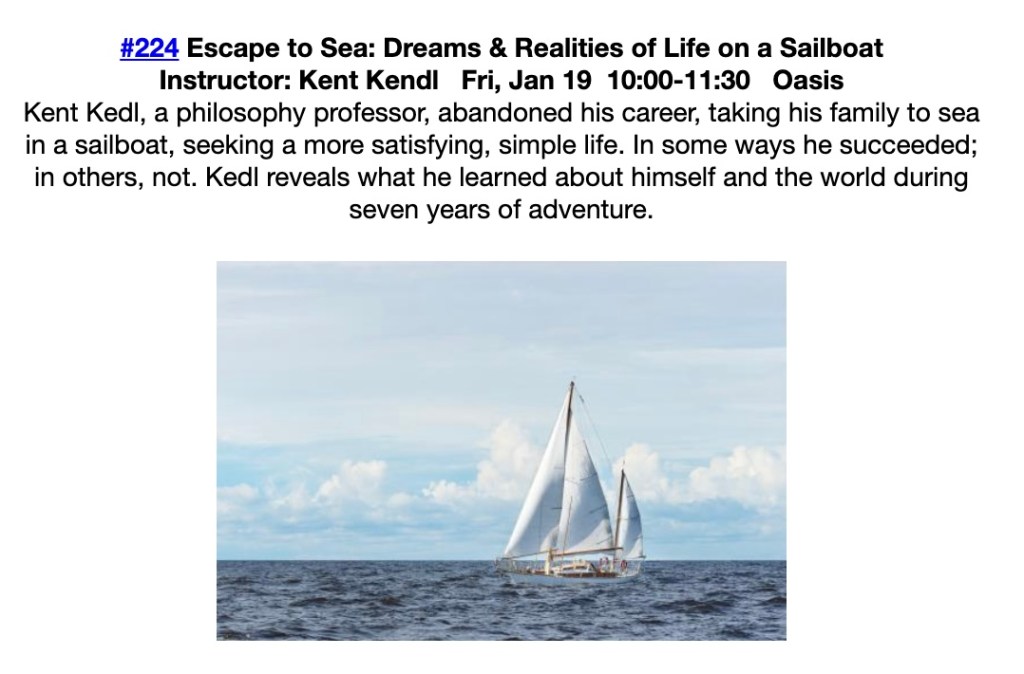
In some ways, he succeeded; in others, not. Kedl reveals what he learned about himself and the world during seven years of adventure – crossing the Atlantic, cruising the Caribbean, sailing through the Great Lakes; and traveling overland through parts of Central and South America. Listen and learn about the grand experiment.Kent Kedl is the author of We Ran Away to Sea: A Memoir and Letters. He has a PhD in philosophy from the University of Oregon and taught at South Dakota State University for 22 years. After returning to land in 2000, he taught philosophy for two more years in South Dakota. He moved to Albuquerque in 2011
For more information and to register click on the Oasis link below. Class number is 224, Cost is $12 plus a minimal registration fee to join Oasis
See new reviews of We Ran Away to Sea posted in the book review section.
Also, good news! The book is now available at the Albuquerque Public Library and there is a waiting list for the two paperback copies we donated: The call number is 813.54 KEDL. Please request they order more copies!
If you know any place that would like to schedule a book talk, please let us know.
This is not our usual Christmas letter since we have been traveling in Scandinavia since December 1, with 12 days on the Hurtigruten Coastal Express from Bergen to Kirkenes, Norway, and back, then to Oslo and Sweden where we’ve been warmly welcomed by my cousin Ingrid and her husband Hans Ove in Norrköping and Olov and Lena in Karlstad where we are spending Christmas.
Despite some disappointing rain, we’ve had beautiful snow, first on the day after our arrival in Bergen and again these past two days in Karlstad. I’m reminded of my Upper Michigan childhood, with snow on the ground for five to six months. Will snow will become a rare experience with global warming?
For much of 2023 we worked on publishing and then promoting Kent and Pam’s book, We Ran Away to Sea. We’re still working on the promotion, but have been gratified that so many of you have us you have enjoyed the book. For those of you in Albuquerque, Kent will be giving an illustrated talk about his sailing years at Oasis at 10:30 am on January 19, 2024.
Other News: We walked parts of the Camino Mozárabe from Alméria to Mérida in Spain during March and April. The terrain was rugged, and at 79 and 82, we are no longer walking the pace we managed ten years ago. From Karlstad we’ll go to Stockholm, then Helsinki and Tallinn, Estonia; and after that a week “somewhere” before we fly home from Amsterdam on January 10.
Polar Night: In the Arctic, we discovered that even during the polar night, when the sun doesn’t rise above the horizon for months, the night is never totally dark, but lighted by reflections from the atmosphere, the white snow, and the moon, stars, and planets. Dawn and dusk follow each other in the space of two or three hours. May we each experience lightness and hope this coming year, even amid the apparent darkness of our polar nights.
Kent and Linnea Christmas in Sweden Copyright (C) 2023 Jacana Press. All rights reserved.
Leave a comment