

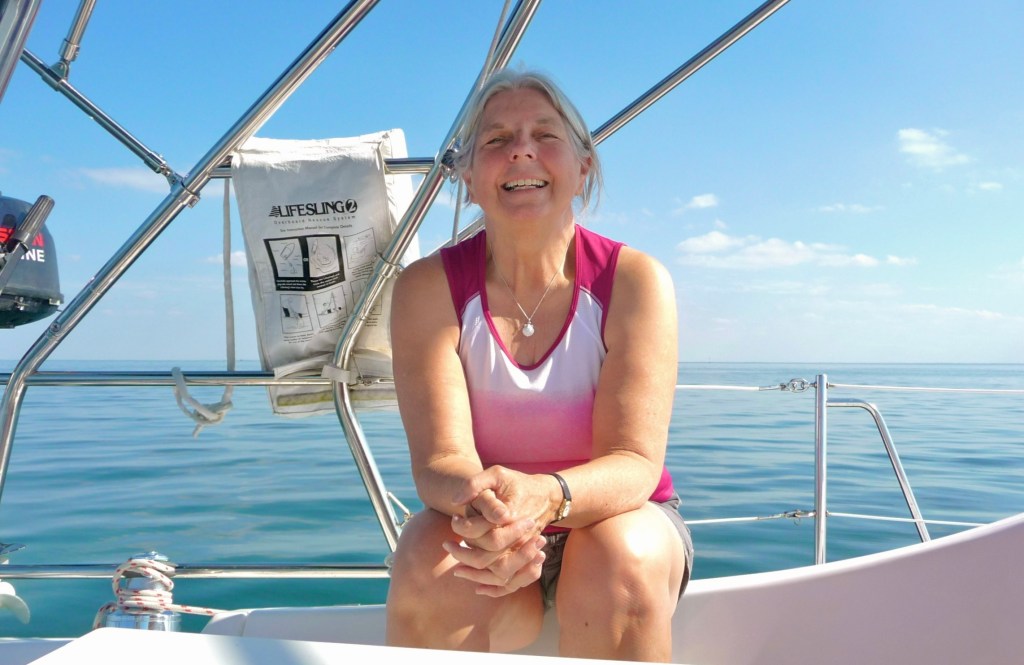
Before the wind hit!
Before Kent and I were married, we set some tests for each other. We survived an international trip, hiked together, and went tent camping. The sailing test remained. Although I had been on many boats, I had never been sailing. So, Kent chartered a boat in St. Petersburg, Florida. I loved the shiny new boat that waited for us at a dock in a rather posh marina. I smiled! I was finally going sailing!
I sensed that Kent was preoccupied and nervous as he familiarized himself with the boat’s systems and contemplated our passage south along the Florida coast. Perhaps unrealistically, I trusted that with his many years of experience, we’d have smooth sailing. I wasn’t worried.
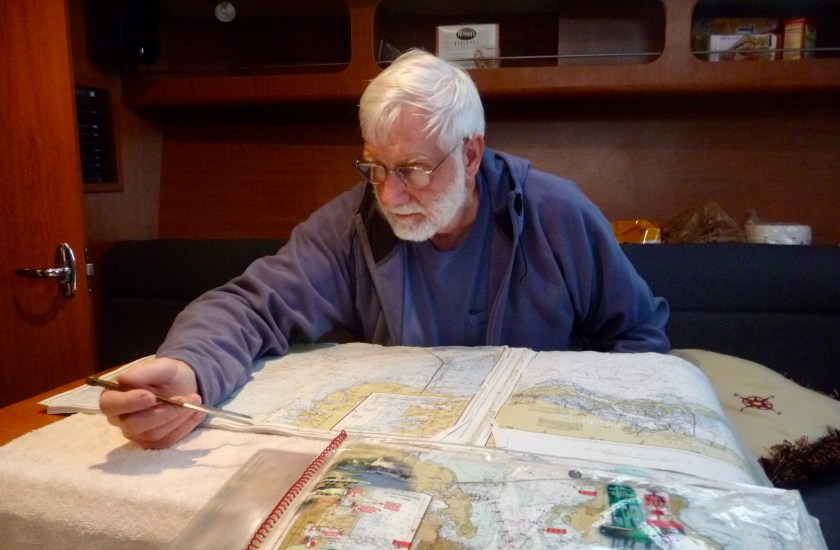
After grocery shopping, we took a shakedown cruise into Tampa Bay. Kent raised the sail, but there was little wind. So after he killed the engine, we lazed in the cockpit, enjoying the February sun and the gentle rocking of the boat. This was the glamorous sailing life I’d dreamed of! We were almost dozing when a gust of wind whacked the sails, the boat heeled, and suddenly we were on the move!
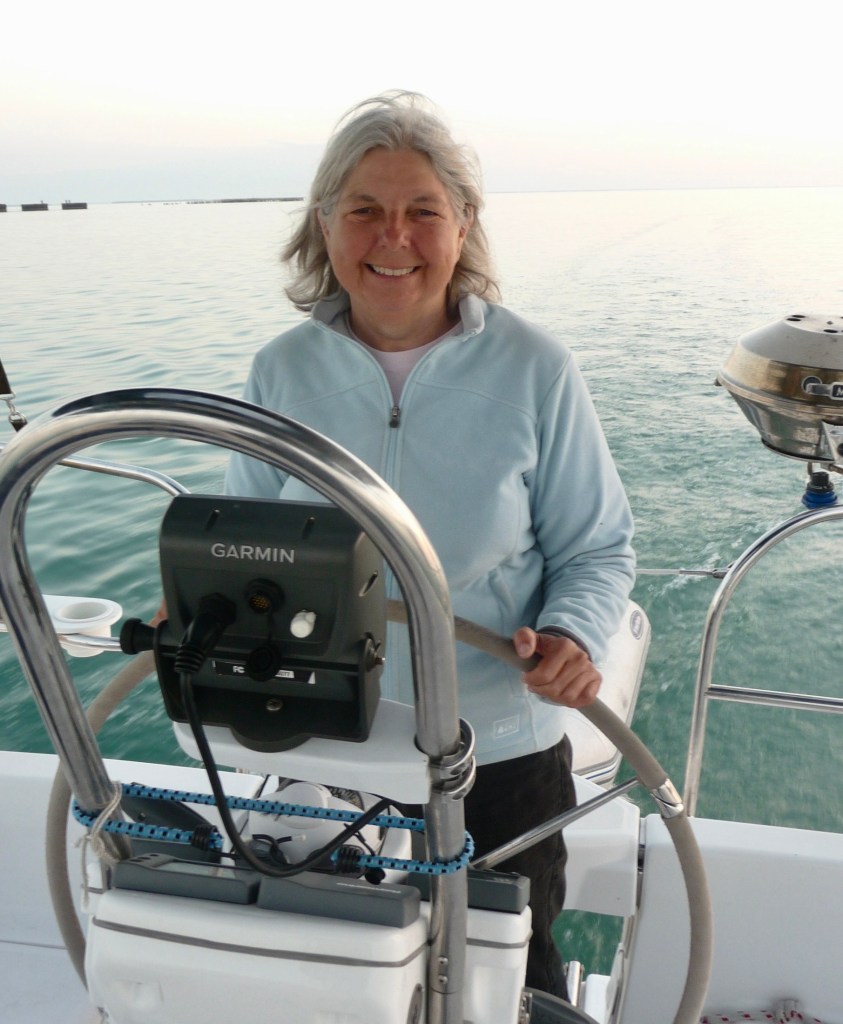
“Take the helm!” Kent shouted. “Point straight ahead!” He went forward to lower the sail, but he couldn’t figure out how the furler worked. Unprintable language blew past. The boat bounced and heeled, and I held tight to the wheel, doing my best to stay upright and steer straight ahead.
My mind raced. What would I do if Kent fell into the water? I pictured him flailing in the waves while the boat sailed on without him. Should I try to save him? How? There are no brakes on a boat. How would I get back to him or the marina? Was this the end of our new life together?
Fortunately, before I dissolved in panic, he figured out the mechanism for the furler, pulled in the sail, and came back to take the helm. I let go, and we hugged each other.
It was time to head back to the marina to meet my cousin for dinner. My hand still shook as I pressed her number on my phone. “We’re out on the bay and should be back on time,” I said.
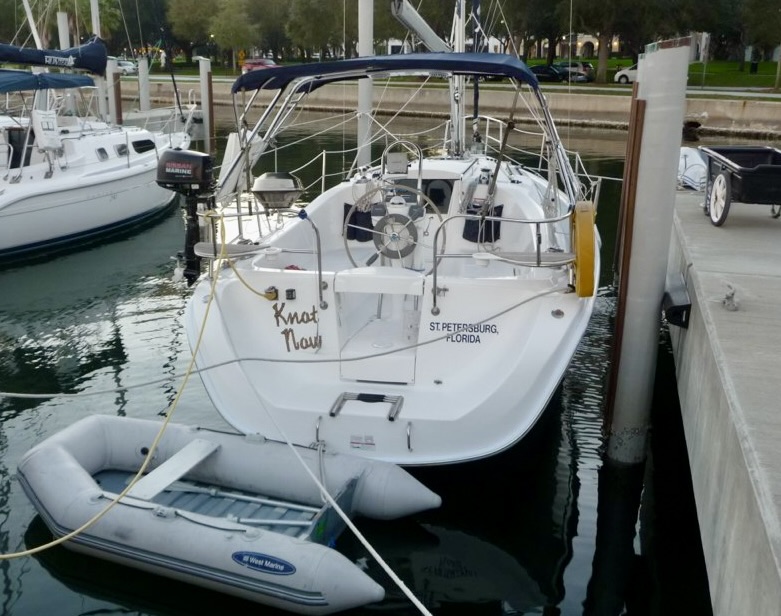
As we neared the marina, Kent looked worried. “I’ve never had a boat that backed up before. I don’t know if I can back it into the slip. We circled past
several times. The space was not much larger than the boat. I have trouble backing up a car. I certainly didn’t want to try it.
I called my cousin again, explaining why we’d be late. She couldn’t stop laughing. “I see you out there! I’ve been in that situation!”
“I don’t know how to do this,” Kent finally confessed, and called the marina, explaining his predicament. A man needs courage to ask for help, and I admired him for doing so.
“Just pull up near the end of the dock!” the voice on the marina phone responded to Kent’s embarrassed call. In a few minutes, a lithe young fellow ran the length of the dock and leaped aboard our slowly moving boat. In minutes, he backed the boat into the narrow slip with nary a bump or scrape.
“I think I could do it now.” Kent thanked our rescuer, who indicated this was no big deal and a common occurrence.
It was the beginning of our Florida sailing adventure. Would our relationship pass the sailing test? More to come next time…
More Sailing Memoirs
I’ve recently read two books, both by young women who sailed as children with their fathers who have written their own, quite different versions of their daughters’ stories. I’m still searching for a copy of Gordon Cook’s elusive book, Schooner to the Southern Oceans: The Captain James Cook Bicentenary Voyage, 1776-1976, and have Tom Neale’s All in the Same Boat : Living Aboard and Cruising.
Boat Kid : How I Susrvived Swimming with Sharks, Being Homeschooled, and Growing up on a sailboat. by Melanie Neale,
It’s rare to find a memoir written by someone so young. Melanie Neale, born in 1979, published this book in 2013. Her story begins with her first introduction to Chez Nous when her parents visit the boat under construction before she is born, and ends when she is 25
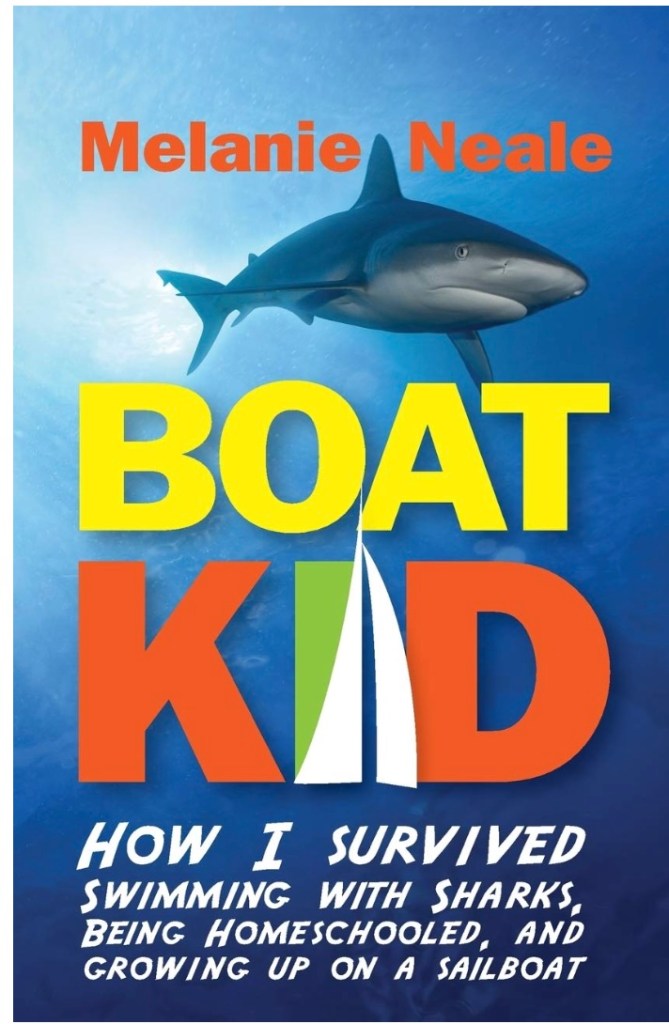
Only after finishing this book did I realize that it was intended as a children’s or young adult book, and that she had previously published Boat Girl (2012), an adult book that covers roughly the same material. The book is arranged chronologically, with each chapter heading including the location, dates, and her age. This made it easy to keep track, since sometimes a year goes by between chapters, especially as she gets older/. Her college years are summarized in one chapter. After finishing this book, I feel compelled to read both the adult book and her father’s account of family life on boats. Reading this and Suzanne Heywood’s memoir of another child who grew up on a boat, and whose father was also a writer, has led me to reflect on both the positive and negative aspects of that experience. Since Kent and Pam also hoped to raise their children on a boat, but gave up after a year, I wonder what it would have been like had they succeeded. I also wonder whether either of his children will end up writing their own version of their months of living on a boat.
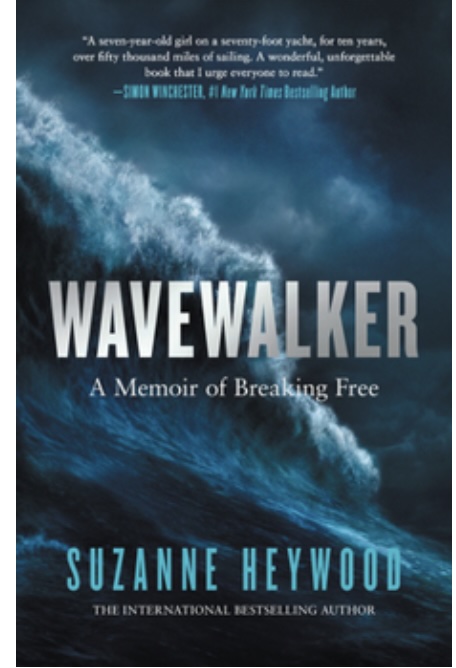
Review of Wavewalker: A Memoir of Breaking Free by Suzanne Heywood.. London: William Collins, 2023
Heywood has written a gripping tale of her incredible and troubling childhood from ages 7 to 17, when she lived on a sailboat with her parents and younger brother. Her father set out with his wife and two children
from their home in England, obsessively intent on retracing Captain Cook’s third voyage on its 200th anniversary in 1976, perhaps as a publicity stunt.
As the intended three-year voyage turns into ten years, he seems to lose track of that goal (after all, the anniversary has passed), and becomes concerned mainly with luring crew to pay to work on the boat for the privilege of making a passage and learning to sail. He takes on several jobs that never seem to last long. The family obviously needs money since their sponsors have backed out, and they have no jobs. Several thoughts occurred to me as I read this book. Probably the biggest one relates to the “breaking free” of the book’s subtitle. What was it like to be imprisoned in someone else’s dream? Even so, Suzanne loves the sea and the boat.
I wonder about the motivations of parents who choose to homeschool their children and/or take them out to sea. Do they seek to take them away from the “ordinary world,” or do they seek to broaden their experience? Do they wish to control them or protect them? Or are they, paradoxically, seeking both of these things? I wondered about this in both Boat Kid, and in Heywood’s book.
Like Neale’s book, the Wavewalker is organized chronologically, with chapter headings that include the dates and the number of days for each section of the voyage. Many passages in the book are beautifully written. The author, like Neale, excels at showing, not telling. The narrator’s voice in the first part of the book sounds much too mature for a seven-year-old, and Heyward has obviously invented most of the conversations throughout the book, although some might come verbatim from her journals, and perhaps even from her parents’ stories.
I would like to know the parents’ version of the story. From the narrative, it is almost certain that they treated their daughter cruelly and unreasonably and favored their son, but this is the daughter’s story, and we see mainly her perspective. The fact that her parents had nothing to do with her when she was writing the book was chilling. Her mother has since died. I hope to read her father’s account, Schooner to the Southern Oceans (2011), but I have been unable to find a copy anywhere, whereas, ironically, Wavewalker is a bestseller. I wonder how many other “boat kids” have written their own versions of their parents’ stories when they grew up.
So long until next time! Linnea and Kent

