In April, we quoted Pam writing about the dinghy under the bed, when she was dreaming of taking off to sea again and leaving the South Dakota winter behind.
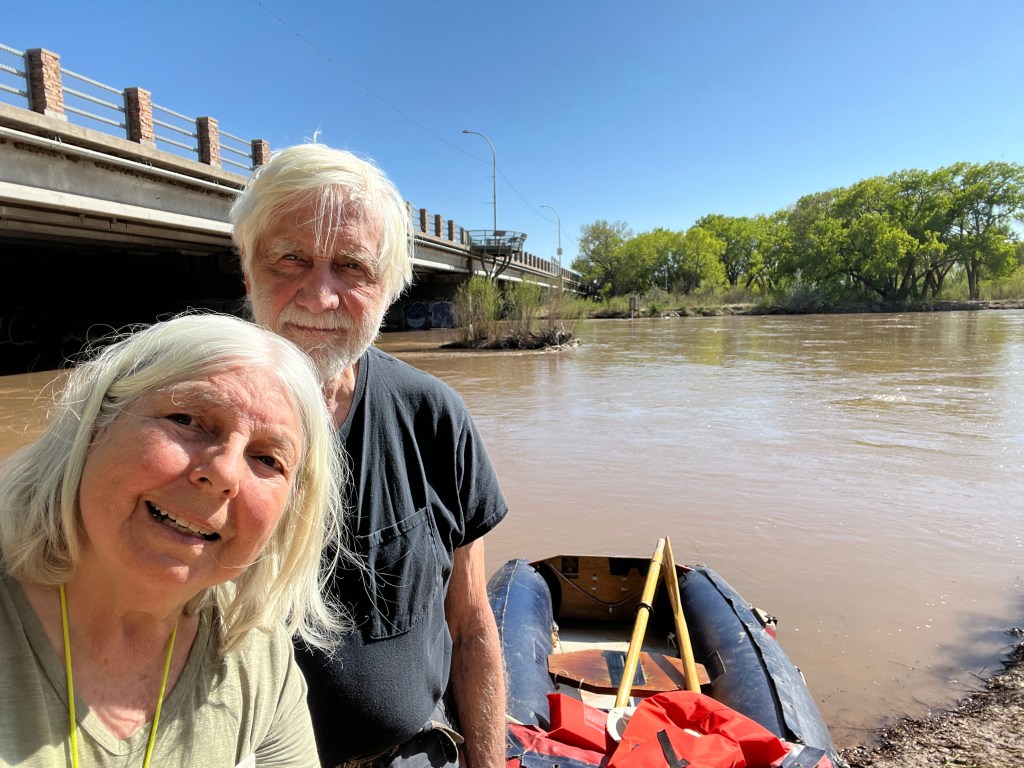
At the end of April, we finally got the old dinghy out on the Rio Grande. Getting it from the back of the car and carrying it to the water and out again was the hard part. Our trip was rather short at about 45 minutes from launch to take-out, but we did it! Paddling down the Rio Grande, we’d never know we were in the midst of a city of over 500,000. It was a little taste of life on the water. Then we went to San Francisco where waves rolled in from the Pacific. I made a short video, hoping whet (wet?) your interest.
We’ve recently had some lovely responses to We Ran Away to Sea. Geoff Boerne, the captain of Lo Entropy, a boat Kent and Pam encountered in Mexico in the 1990s, last week finally received the copy of the book we’d sent him at the end of February. Apparently it takes a long time to get a book to Denmark! He tells us he started reading on Friday evening and finished the book on Saturday afternoon, sad to have it come to an end. He also saw the book as not just a sailing book, but a love story, which I, too, think it is. He had much more to say, and, of course, identified with all the sailing bits. Thank you, Geoff!
There is more about Geoff and his current endeavors in today’s blog post. Check out what he and Peter Roberts are doing to help save our planet, by clicking the following link on my Caminobleu blog:
Kent will be giving a book talk: Saturday, June 29 from 1-2 p.m at the Juan Tabo branch of the Albuquerque Public Library.
He will also be selling and signing books with a few other authors on Saturday, July 6 at the lovely Garcia Street Books, Santa Fe, from 10-12 am. We hope to see some of our Santa Fe friends!
Three copies of the book are now available at the Albuquerque Public Library, and there is a waiting list! The call number is 813.54 KEDL. Please request more copies!
We Still Need More Reviews
Check out the new reviews on Amazon and on our webpage: Follow Kent’s author page by clicking on follow on Amazon. We need more reviews! Good Reads is another place to put reviews. Can you help us get up to 50? We’re almost there! See the help on posting reviews a bit farther down the page.
There was a sudden spike in book sales in early June for three days in a row. That was a welcome mystery, and we hope it keeps up.
I also added some new content to the book page on Amazon. But, oops! Only part of the content appears on the paperback page. It’s all there on the Kindle page, so look there for now, and I’ll try to fix it tomorrow.
Send us a picture of you reading the book
Please send us your picture of you or someone reading the book or seeing the book in interesting places.
Esther Jantzen, author of Walk: Jamie Bacon’s Secret MIssion on the Camino de Santiago, and founder of Elder Activist Readers, enjoying We Ran Away to Sea.
Return from Indonesia
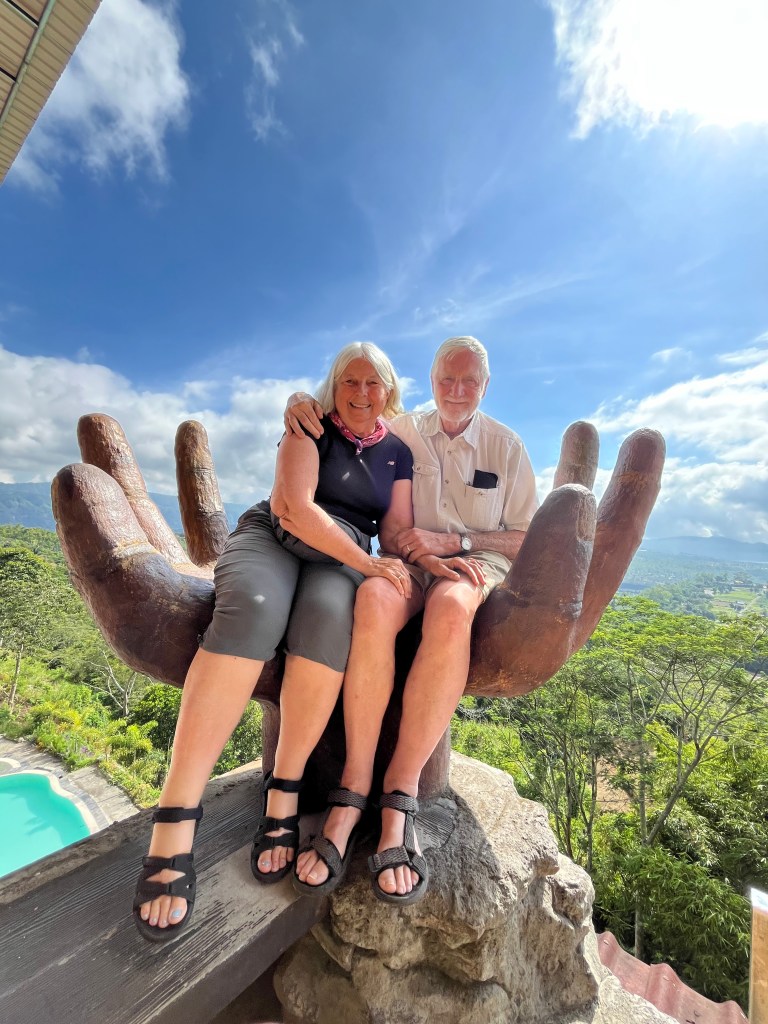
We took a break from book stuff for three weeks in May and enjoyed a fascinating impromptu trip to Indonesia. We were so captivated by our experiences that we totally forgot to take pictures with the book in the many intriguing and scenic places we visited. Alas! But here we are, without the book!
Linnea and Kent riding high in the sky in Bali, Indonesia
Rio Grande from Central Avenue Bridge, Albuquerque
If you have read We Ran Away to Sea, you know that Pam and Kent ran away partly because they were concerned about the environmental impact of America’s consumer-driven lifestyle.
Elder Activist Readers (EAR)
More recently, Kent and I have participated in book discussions in a small group we call EAR (Elder Activist Readers), spearheaded by Esther Jantzen, the author of the children’s novel Walk: Jamie Bacon’s Secret Mission on the Camino de Santiago. Esther, like me, was inspired by her experiences as a pilgrim. Over the past three years, our little reading group has read eighteen books and become more knowledgeable about the environmental threats to our planet. We’ve also studied the history of our current crisis and have taken small steps to support people and organizations working on solutions.
Geoff Boerne
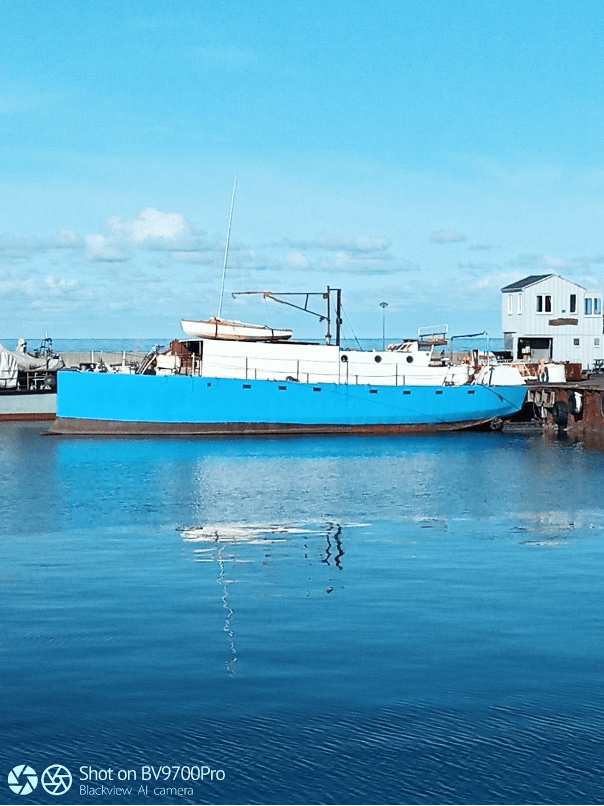
Pam and Kent encountered Geoff Boerne’s Lo Entropy in Mexico in the 1990s. Sailed by two young Brits, Ian and Alan, the ship seemed to be in dire straits the last time Pam and Kent saw her. Kent concluded his Lo Entropy story, “I would like to think Alan made a go of his venture in the end, but it certainly looked like Lo Entropy had run out of energy.”
So, what did happen to her? I discovered a film on YouTube, The Cuba Connection by Claudio von Planta, telling the story of the ship before Pam and Kent met her. Lo Entropy was constructed mainly of recycled materials, although most of the steel had to be purchased new. Her first mission was a partly successful attempt to deliver donated supplies to Cuba, where people were suffering from the impact of the United States boycotts.
I discovered a website authored by Geoff Boerne, the majority shareholder and Managing Director of Celtic Cruises Ltd., whose only asset is Lo Entropy. Geoff and another unpaid director, Nick Rodgers, are endeavoring to keep Lo Entropy afloat as a wind and hydrogen-powered transport vessel.
According to the Transport Environment website, shipping produces at least three percent of the transport industry’s carbon. Googling “sailing and hydrogen” reveals numerous websites and articles about recent efforts to create “zero energy” shipping. In 2022, Geoff Boerne published “A Milestone for Sail Cargo Pilot Project: Goal and Hydrogen Concept.” Cruise and transport companies such as Norway’s Hurtigruten (which plans to launch an energy-efficient cruise ship by 2030) are looking into zero-energy transport. A return to sailing ships, assisted by green technology, is a promising alternative to diesel fuels. Maybe in the future, we will all, like Greta Thunberg, be crossing the oceans under wind power.
Geoff wrote to me, “Lo Entropy’s sails are currently assisted by an electric motor that doubles as a powerful generator when the propeller is free-spinning or driven by the diesel engine. We hope to replace the diesel engine with a hydrogen-fueled (ICE) internal combustion engine. Times are changing. Toyota has now produced a hydrogen combustion engine, so we are considering eliminating the expensive fuel cell and using hydrogen to fuel a hydrogen combustion engine.”
A hydrogen system combined with wind and solar will produce energy for a two-hour capacity battery bank that will convert the excess energy to hydrogen and store it for propulsion when needed. Geoff is seeking investors to help refit the vessel. He now lives in Denmark and can be contacted through his website https://www.greenseatransport.com/ or his email address, Loentropy@gmail.com)
Lo Entropy, 2024
Peter Roberts
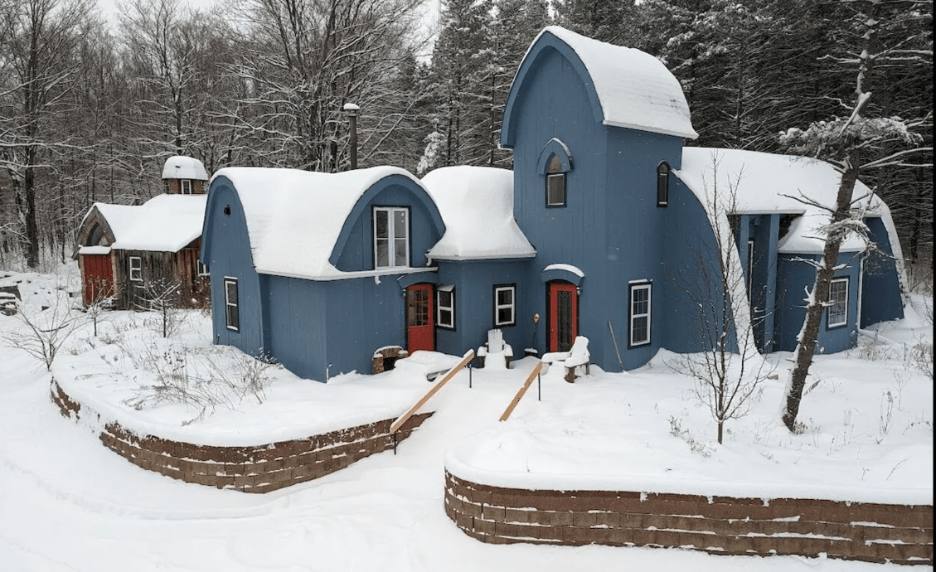
Peter met with EAR on February 29, 2024, to tell us about his work and its place in the future of green building. Peter has two web pages, and some wonderful videos have been made about his work. He recently completed his model masonry house, which is now available to rent through VRBO and Airbnb. Peter also holds several patents.
Peter Roberts’ house in Alfred, New York
He gave a fascinating overview of what he sees as problems and possible solutions to the considerable amount of carbon produced by the construction industry. He told us that cement is one of the most commonly used materials on earth. Second only to water. The construction industry, which amounts to about four trillion dollars worldwide, is conservative and slow to change. However, there are new ways of making cement, using materials other than the traditional limestone and clay that are mined, ground to a fine powder, and then heated at very high temperatures. Peter explained many of the new techniques, including using volcanic material as the ancient Romans did to make constructions that are still standing after two thousand years. I confess that until I listened to Peter, I didn’t know that cement and concrete were two different things, even though we often use them interchangeably in everyday language. Cement is the binding ingredient that is essential in making concrete. There is much information available on all of this. A good starting place might be:
Learning about the work of Geoff Boerne and Peter Roberts gives me hope for a more sustainable future for our planet. Please contact either of them if you would like more information or are interested in helping with their endeavors. Perhaps one day we’ll have zero carbon emission and create concrete boats propelled by wind and hydrogen?
18) Thomas Hübl, Attuned: Practicing Interdependence to Heal Our Trauma—and Our World, pub 2023 (read Feb-Mar 2024)
17) Deb Chachra: How Infrastructure Works: Inside the Systems That Shape Our World, pub 2023 (read Jan 2024)
16) Edward Struzik, Swamplands: Tundra Beavers, Quaking Bogs, and the Improbable World of Peat, pub 2021 (read Oct 2023)
15) Joy Harjo, Poet Warrior: A Memoir(poet laureate) read ???
14) Sarah Augustine, The Land Is Not Empty, pub 2021 (read Jun 2023)
13) Amitav Ghosh, The Nutmeg’s Curse, pub 2022 (read Mar 2023)
12) E.F. Schumaker, Small Is Beautiful, pub 1973 (read Dec 2022)
11) Vanessa Machado de Oliveira, Hospicing Modernity: Facing Humanity’s Wrongs and the Implications for Social Activism, pub 2021 (read Oct 22)
10) Imbolo Mbue, How Beautiful We Were, pub 2021 (read Aug 2022)
9) Robin Wall Kimmerer, Braiding Sweetgrass,pub 2013 (June 2022)
8) Kristen Olsen, The Soil Will Save Us, pub 2014 (read Apr/May 2022)
7) Paul Hawken, Regeneration: Ending the Climate Crisis in One Generation,pub 2021 (read Feb/Mar 2022)
6) Lydia Millet, A Children’s Bible, pub 2020—a novel (read Jan 2022)
5) asknature.org website —created by Janine Benyus, Biomimicry Institute (studied Oct 2021)
4) Kate Haworth, Doughnut Economics: Seven Ways to Think Like a 21st Century Economist, pub 2017 (read Jul/Aug 2021)
3) Arlie Hochschild, Strangers in Their Own Land: Anger and Mourning on the American Right, pub 2016 (read June 2021)
2) Shalanda H. Baker’s Revolutionary Power: An Activist’s Guide to the Energy Transition,pub 2021 (read Mar-Apr 2021)
1) Ayana Elizabeth Johnson and Katharine K Wilkerson (eds), All We Can Save: Truth, Courage, and Solutions for the Climate Crisis, pub 2020 (read Jan 2021)
Also, we’ve reviewed some articles and digital resources, including:
Jeremy Lent—Patterns of Meaning (Mar 2022) blog piece on climate change and capitalism NMHealthySoil.org New York Times article on chicken Kiss the Ground (video)





 Jacana Press