A mysterious heavy padded envelope arrived in the mail. What could it be?
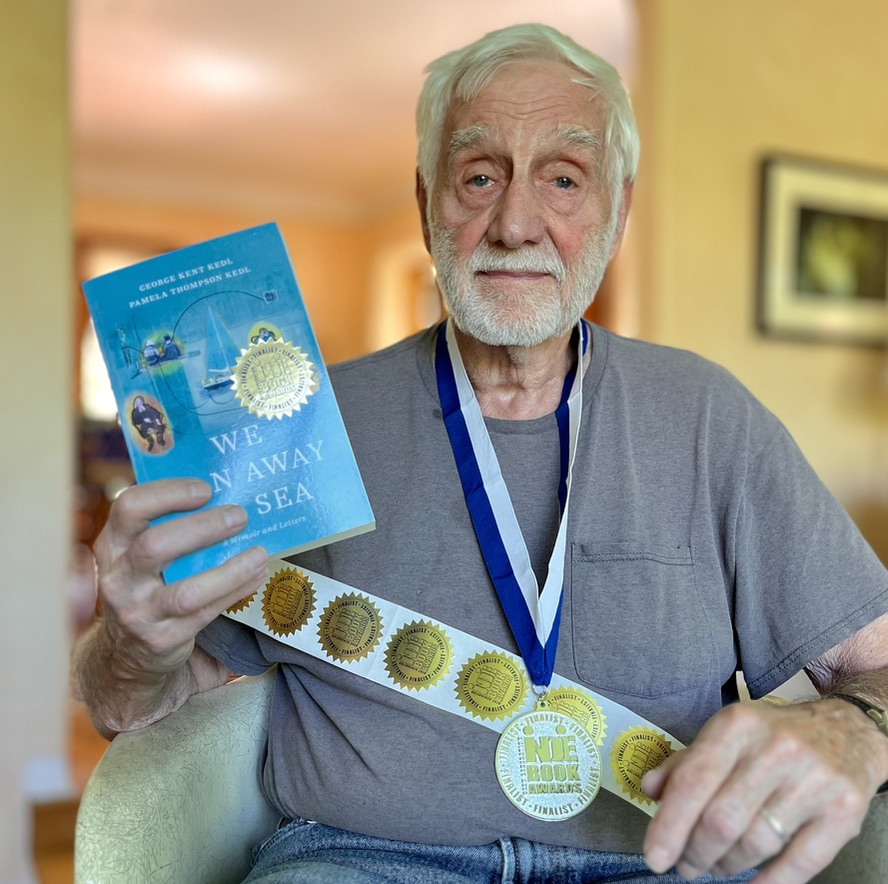
“I think I won an award!” Kent said.
Sure enough. We unwrapped the package and inside was a heavy silver medal with a blue ribbon, a booklet listing all the 2025 Next Generation Indie Book Awards, and a sheet of stickers. It turns out We Ran Away to Sea was a FINALIST in the memoir category. This was not a high enough ranking to earn him an invitation to the awards ceremony that was held in conjunction with the American Library Association annual meeting in Philadelphia (wouldn’t that have been fun?), but we were pleased nevertheless.
We are done with entering book awards, although, I suppose we could consider entering a contest for an AI generated audio book, if there is such a thing.
We received nice review of the audio book (available through Amazon Audible) shortly after the audio book was published. We don’t know who CHS is, but thank you!
As soon as the audiobook was available, I purchased it. Enjoyed going on this adventure with the authors. I learned sailing can be a lot of work. I was very impressed with AI narrator. — CHS
Reviewed in the United States on April 29, 2025
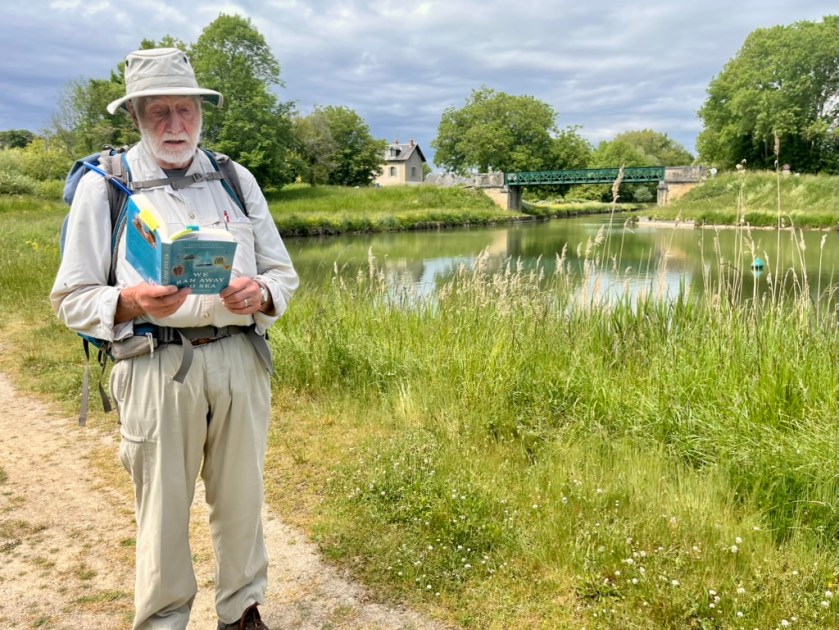
Impromptu video from France
We carried a copy of We Ran Away to Sea during our walk in France, but seldom remembered to take it out of Kent’s backpack. But one day as we walked along a canal, we did. The video is on TikTok.
Amazon notified us last week that We Ran Away to Sea was eligible to participate in the beta digital voice program to create an audiobook. We’d wanted to do an audiobook forever, preferably in two voices, to mirror Pam and Kent’s parts of the book.
We picked out male and female American accented voices we liked, followed the directions, and voilá, like magic, with a pause of only fifteen seconds, the chosen voice read the Prologue with scarcely a hitch, not sounding at all like a computer-generated voice. I’m thinking of Hal from Space Odyssey 2001, which is from the last century. You can tell how old we are!
How we did it
Kent spent most of the weekend, when we weren’t at the Hands Off Rally at Albuquerque’s Civic Plaza, “reading” or perhaps “listening” to the book, chapter by chapter, and correcting pronunciation errors. We had special difficulties with the Spanish place names such as Málaga, Mérida, and Carasí, as well as the pronunciation of wind and wind — as in “blowing wind” and “wind up”. It was rather jarring to hear the title Wind in the Willows as “wined in the willows.”
We learned that although we could change male and female voices chapter by chapter, there was no way to change the voices in mid-chapter. So, Kent decided to have the entire book read in a male voice. We had to give up my original dream of having an interplay of male and female voices, representing Kent and Pam. We were able to use the pronunciation correction tab to insert the name of the person speaking by replacing the beginning words of a paragraph and including the speaker’s name in places where the switch in speakers could be confusing. In the printed version, we had initially considered prefacing each change in voice by inserting the person’s name, e.g., Kent: Bla-bla-bla or Pam: Bla-bla-bla, but in the end, we chose to indent the sections in which Pam is writing (speaking) to differentiate the two voices.
Strengths and Weaknesses
(1) It is amazing the way the digital voice picks up inflections and pronounces most words flawlessly, even ones I would have to think about or look up before saying them aloud. We did. have difficulty correcting pronunciations of Spanish place names, which were not pronounced consistently. A blind reader commented that the digital voice readings were much better than the usual text to speech applications generally available. I am sorry our blind friend Craig did not live to listen to our book.
(2) Although we initially hoped to narrate the book ourselves, we weren’t sure our voices would be good enough and the reading and editing would have taken an estimated 40 to 50 hours. Paying someone to do this would cost several thousand dollars.
(3) We found typos and mistakes that we had not previously noticed, even though we had read aloud to each other as we were editing. Good!
(4) We found the book surprisingly pleasant to listen to. Hey, it’s a good story!
(5) We were not able to eliminate things like names of the maps, and all the back matter, such as a timeline, glossary, and bibliography. Listeners will have to fast-forward or skip through these. It would be nice to have more flexibility in eliminating sections.
(6) The audiobook is only available through Audible, not accessible through libraries or other listening systems.
(7) In writing future books I will be more aware of formatting decisions that will impact an audiobook format.
We’d love your feedback, and we hope that Amazon will make some improvements, such as allowing switching voices within chapters and making the pronunciation of Spanish placenames more consistent. If you purchase the Kindle book from Amazon for $6.99, you can add the audiobook for only $1.99 more. If you want to buy the audiobook as a stand-alone, the cost is $7.99.





 Jacana Press