Mysteries of the Deep

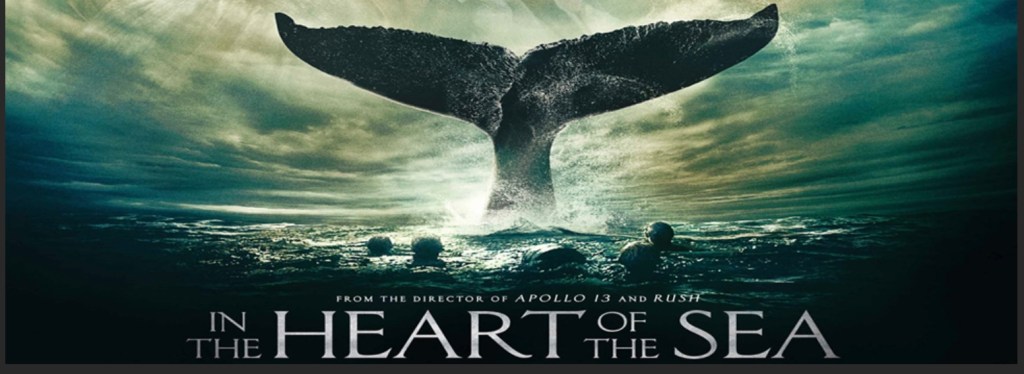
I recently watched In the Heart of the Sea, a 2015 movie directed by Ron Howard and based on Nathaniel Philbrick’s book of the same name, which tells the story of the whaling ship Essex, stoved in by a white whale and sunk in the Pacific in 1820. This story inspired Melville’s Moby Dick.

One scene in the movie resonated with me.

After the whale sinks the ship and wreaks havoc upon its crew, he later emerges from the depths and lies alongside a small boat of desperate survivors. Chase, the lead character in the story, an ambitious, dedicated whaler, grabs a harpoon and stands ready to thrust it into the whale: Chase’s eyes and the whale’s eye lock. Chase hesitates. The captain urges him to thrust the harpoon. Chase continues to hesitate, still holding the harpoon, eye to eye with the whale, and watches, transfixed, as the whale sinks into the deep and swims away to its own uncertain future, leaving the destitute whalers to survive as best they can.

In 1984, I gave up my profession, home, possessions, and the only life I’d ever known. With only a dream and the money freed by selling up, I took my family and set out to create a life at sea. Our first sail was across the Atlantic from England (where we found our boat) to the Caribbean. Between learning to sail and navigate, modifying and repairing the boat to make it deep-sea-ready, and trying to keep my reluctant family together, I had little time or energy to learn much about the creatures of the sea.

Halfway across the ocean, we were becalmed in an endless, flat sea. A swordfish as long as our 38’ boat surfaced next to us. It rolled on its side to study us with one large, round eye staring directly at us. It did not seem threatening or menacing, but what did I know? I had no harpoon at the ready. I was not afraid. Nor was I angry or seeking revenge like Chase. I watched, as after several minutes it sank quietly back into the deep.

A deep emotion welled up within me. When I stared into that eye, I was humbled, even ashamed, to have invaded the fish’s home in such ignorance. We humans confront nature with such arrogance!

Unlike Melville’s Captain Ahab, Chase gave up whaling and became an independent ship captain in the Merchant Marine. Perhaps, while staring into the whale’s eye, he also came to acknowledge his shameful disrespect for the natural world and its creatures.

Wild creatures’ eyes can penetrate deeply into the soul. Think of Aldo Leopold’s famous, life-changing story of watching the eyes of the dying wolf that he had just shot.  “I realized then, and have known ever since, that there was something new to me in those eyes – something known only to her and the mountain.” (A Sand County Almanac). — G. Kent Kedl

A Memory, Moby-Dick, and a Song

After seeing the film In the Heart of the Sea and recalling Kent’s encounter with the swordfish, I remembered my first reading of Moby-Dick.

I was living in New York City and taking a class in American Literature with Nick Lyons at Hunter College. Do you know that sometimes the book title is written Moby Dick and sometimes hyphenated Moby-Dick?  An internet search turns up intense discussions on this burning issue. Lyons, who later became a publisher known for his writings on trout fishing, preferred the hyphenated title.


While some people think Melvillle’s detailed descriptions of the natural history of whales interrupt the flow of the story, they were some of my favorite parts of the book. They sparked what has become a lifelong love of whales and other wonders of the seas.

During those years, I had a friend I hoped would be my boyfriend — something that never quite happened, an experience that haunted me until he found me again some fifty years and two husbands later, but that’s another story. 

Bobby’s occasional, usually unannounced, visits would last for hours. We often took long walks through lower Manhattan from my apartment on East 7th Street, sometimes to the West Village to places he knew had been lived in or frequented by Dylan Thomas, Edna St. Vincent Millay,  e.e. cummings, and others, or to the Staten Island Ferry, where we rode back and forth as many times as we wanted for ten cents. We recited the refrain of Edna St. Vincent Millay’s “Recuerdo” to each other and pretended to search for whales.

“We were very tired, we were very merry—
We had gone back and forth all night on the ferry.”

Bobby not only shared my love of literature and long, rambling walks, he was a poet who wrote songs and played the guitar. In those pre-internet days, we riffled through my collection of songbooks to find songs that one or the other of us knew. It was Bobby who taught me “Spanish Is the Lovin’ Tongue.” He also introduced me to the writings of Henry Miller and Anaïs Nin.

Our discussions of Moby-Dick inspired me to write a song. I was pleased that Bobby admired the Dick, flick, and trick lines. We sang it together.

Now and then, I sing snatches of the song to myself.

 But, the other day, I could remember only two stanzas and the chorus. A little later, another couple of lines pushed into my brain. Was there more?

Surely, I’d saved a written copy? But where? I found two files labeled poetry in one file drawer and a loose-leaf notebook labeled “I am Eating Poetry” (from a poem by Mark Strand) that I had used when teaching, but they contained no poems I had written.

A search of the garage uncovered dusty boxes containing many files of treasures and many that should be thrown away. But, a folder labeled, “Poems – Mine!” delivered on the top of the pages a poem beginning, “Oh that stormy old weather…” and seven stanzas, four of which I’d entirely forgotten. Memorable or not, they form a much condensed musical version of Moby-Dick.

That Stormy Old Weather

A much condensed musical version of Moby-Dick.  See also the video with me singing on YouTube.

Chorus:

Oh, that stormy old weather
That windy old weather
When the wind blows, boys
We’ll all go together.

A fellow named Ishmael
Related a wild tale
Of how he went sailing
In search of a white whale.

Perched high on the mast
With the sea floating past
Ishmael had his visions
And dreams he held fast.

While Queequeg was often
At work on his coffin
Men knew by the sea-signs
When whales were in the offin’.

Then up jumped old Ahab,
Old peg-legged Ahab
And said, “There she blows, boys!”
“We’ll all go together.

“Look out for Moby-Dick
He’s up to any trick
We’ll all go down under
When he gives his tail a flick.”

Entrapped in those great jaws
No time to think or pause
Were they the victims of
Fate or Divine laws?

Ishmael alone
Did not sink like a stone,
He clung to the coffin
That Queequeg had known.

Chorus (repeat)

-- Linnea Hendrickson

Do You Know These Facts about Whales?

  • Male Sperm Whales turn white as they age.  The whiter the whale, the older it is. Moby Dick is not a myth.
  • Sperm whales sleep in a vertical position in the water. Unlike humans, they need to be awake to breathe, so while one-half of the brain sleeps, the other half remains alert, allowing them to breathe and watch for predators.
  • Depending on their pitch, whale sounds can travel 6000 to 10000 km underwater.  Noise from the engines of boats and ships disturbs their communication patterns.
  • Whales can dive to a depth of 1 to 2,000 meters (more than half a mile to more than a mile deep) and can stay underwater without breathing for an hour or more, depending on the species.
  • Whales and dolphins are mammals who nurse their young and have complex family and social systems. Their closeness is one reason that when one whale is beached, others follow, even to their deaths.
  • The great blue whale is the largest animal that has ever lived. Commercial whaling has been banned worldwide since 1986, except for Norway, Iceland, and Indigenous people. Still, many whales are killed by encounters with ships, and some killings are justified as “scientific.”

For more information on all forms of sea life, see Oceana.org
For an excellent 50-minute video about one man’s intense fascination with Sperm Whales, see the PBS nature film 
Patrick and the Whale.

June’s Bustin’ Out All Over

Who wants to sail or paddle down the Rio Grande?

In April, we quoted Pam writing about the dinghy under the bed, when she was dreaming of taking off to sea again and leaving the South Dakota winter behind.

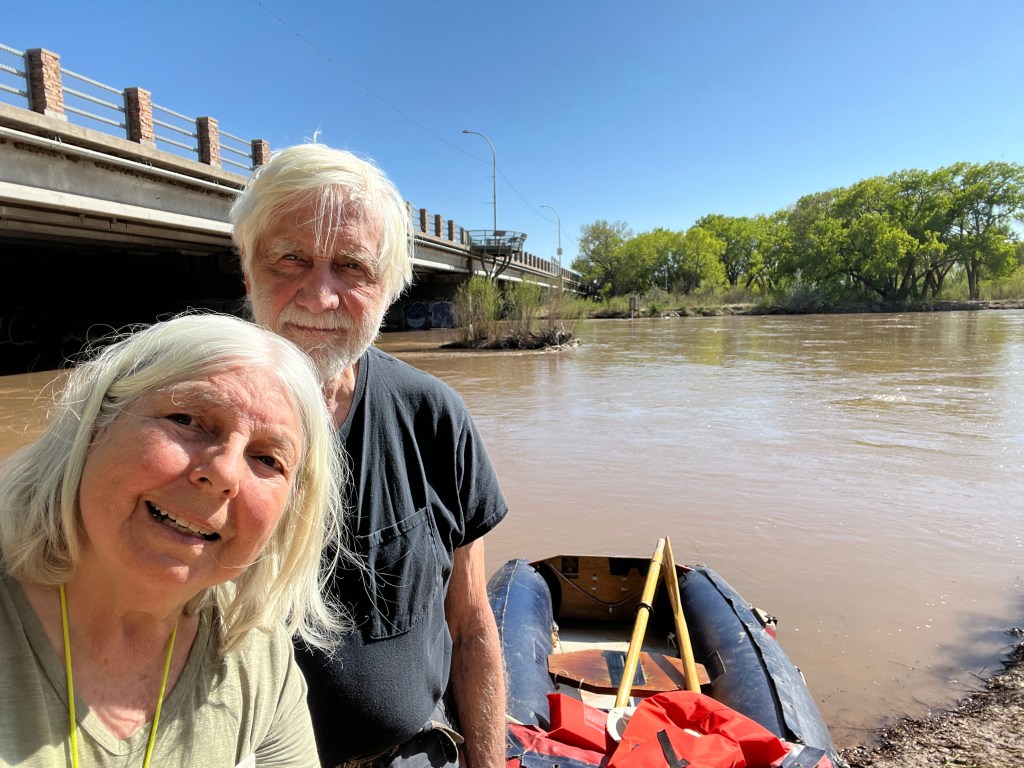
At the end of April, we finally got the old dinghy out on the Rio Grande.  Getting it from the back of the car and carrying it to the water and out again was the hard part. Our trip was rather short at about 45 minutes from launch to take-out, but we did it!  Paddling down the Rio Grande, we’d never know we were in the midst of a city of over 500,000.  It was a little taste of life on the water. Then we went to San Francisco where waves rolled in from the Pacific.  I made a short video, hoping whet (wet?) your interest.

A lovely response to We Ran Away to Sea

We’ve recently had some lovely responses to We Ran Away to Sea. Geoff Boerne, the captain of Lo Entropy, a boat Kent and Pam encountered in Mexico in the 1990s, last week finally received the copy of the book we’d sent him at the end of February. Apparently it takes a long time to get a book to Denmark! He tells us he started reading on Friday evening and finished the book on Saturday afternoon, sad to have it come to an end. He also saw the book as not just a sailing book, but a love story, which I, too, think it is.  He had much more to say, and, of course, identified with all the sailing bits.  Thank you, Geoff!

June-July Events – Mark Your Calendars!

Kent will be giving a book talk: Saturday, June 29 from 1-2 p.m at the Juan Tabo branch of the Albuquerque Public Library.

He will also be selling and signing books with a few other authors on Saturday, July 6 at the lovely Garcia Street Books, Santa Fe, from 10-12 am. We hope to see some of our Santa Fe friends!

Three copies of the book are now available at the Albuquerque Public Library, and there is a waiting list! The call number is 813.54 KEDL. Please request more copies!

We Still Need More Reviews

Check out the new reviews on Amazon and on our webpage:  Follow Kent’s author page by clicking on follow on Amazon.  We need more reviews!  Good Reads is another place to put reviews. Can you help us get up to 50? We’re almost there! See the help on posting reviews a bit farther down the page.

There was a sudden spike in book sales in early June for three days in a row. That was a welcome mystery, and we hope it keeps up.

I also added some new content to the book page on Amazon. But, oops! Only part of the content appears on the paperback page. It’s all there on the Kindle page, so look there for now, and I’ll try to fix it tomorrow.

Send us a picture of you reading the book

Please send us your picture of you or someone reading the book or seeing the book in interesting places.

Esther Jantzen, author of Walk: Jamie Bacon’s Secret MIssion on the Camino de Santiago, and founder of Elder Activist Readers, enjoying We Ran Away to Sea.

Return from Indonesia

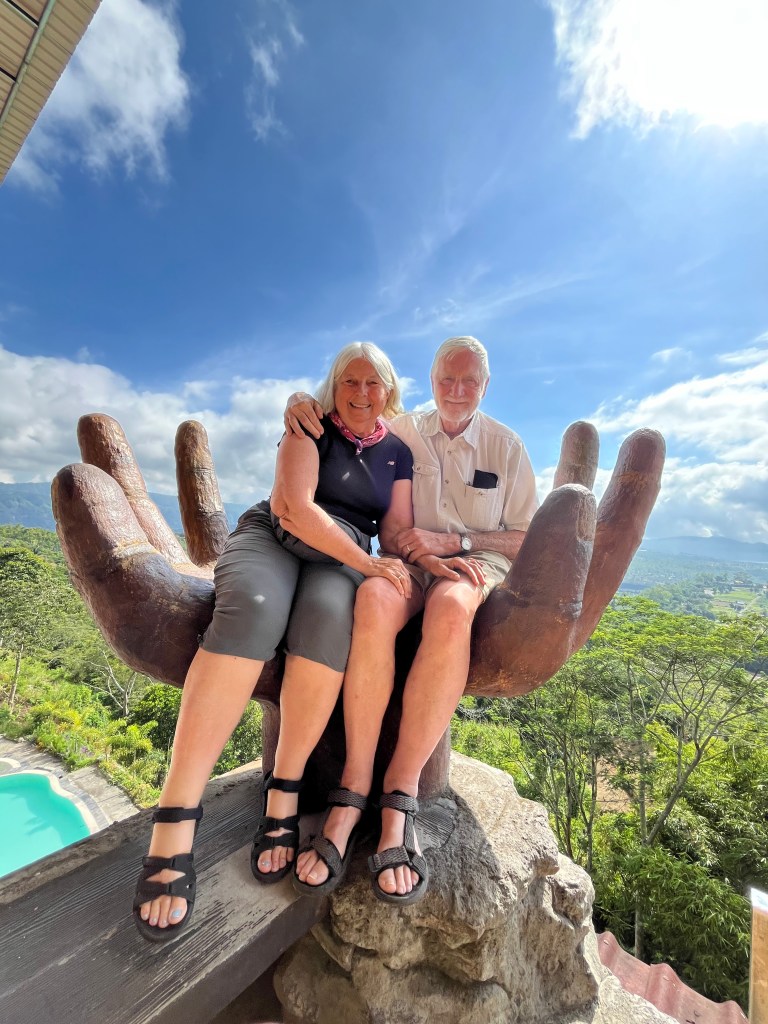
We took a break from book stuff for three weeks in May and enjoyed a fascinating impromptu trip to Indonesia. We were so captivated by our experiences that we totally forgot to take pictures with the book in the many intriguing and scenic places we visited. Alas! But here we are, without the book!

Linnea and Kent riding high in the sky in Bali, Indonesia

Can We Save the Planet?

Rio Grande from Central Avenue Bridge, Albuquerque

If you have read We Ran Away to Sea, you know that Pam and Kent ran away partly because they were concerned about the environmental impact of America’s consumer-driven lifestyle.

Elder Activist Readers (EAR)

More recently, Kent and I have participated in book discussions in a small group we call EAR (Elder Activist Readers), spearheaded by Esther Jantzen, the author of the children’s novel Walk: Jamie Bacon’s Secret Mission on the Camino de Santiago. Esther, like me, was inspired by her experiences as a pilgrim. Over the past three years, our little reading group has read eighteen books and become more knowledgeable about the environmental threats to our planet. We’ve also studied the history of our current crisis and have taken small steps to support people and organizations working on solutions.

Geoff Boerne

Pam and Kent encountered Geoff Boerne’s Lo Entropy in Mexico in the 1990s. Sailed by two young Brits, Ian and Alan, the ship seemed to be in dire straits the last time Pam and Kent saw her. Kent concluded his Lo Entropy story, “I would like to think Alan made a go of his venture in the end, but it certainly looked like Lo Entropy had run out of energy.”

So, what did happen to her?  I discovered a film on YouTube, The Cuba Connection by Claudio von Planta, telling the story of the ship before Pam and Kent met her. Lo Entropy was constructed mainly of recycled materials, although most of the steel had to be purchased new. Her first mission was a partly successful attempt to deliver donated supplies to Cuba, where people were suffering from the impact of the United States boycotts.

I discovered a website authored by Geoff Boerne, the majority shareholder and Managing Director of Celtic Cruises Ltd., whose only asset is Lo Entropy. Geoff and another unpaid director, Nick Rodgers, are endeavoring to keep Lo Entropy afloat as a wind and hydrogen-powered transport vessel.

According to the Transport Environment website, shipping produces at least three percent of the transport industry’s carbon. Googling “sailing and hydrogen” reveals numerous websites and articles about recent efforts to create “zero energy” shipping. In 2022, Geoff Boerne published “A Milestone for Sail Cargo Pilot Project: Goal and Hydrogen Concept.”  Cruise and transport companies such as Norway’s Hurtigruten (which plans to launch an energy-efficient cruise ship by 2030) are looking into zero-energy transport. A return to sailing ships, assisted by green technology, is a promising alternative to diesel fuels. Maybe in the future, we will all, like Greta Thunberg, be crossing the oceans under wind power.

Geoff wrote to me, “Lo Entropy’s sails are currently assisted by an electric motor that doubles as a powerful generator when the propeller is free-spinning or driven by the diesel engine. We hope to replace the diesel engine with a hydrogen-fueled (ICE) internal combustion engine. Times are changing. Toyota has now produced a hydrogen combustion engine, so we are considering eliminating the expensive fuel cell and using hydrogen to fuel a hydrogen combustion engine.” 

A hydrogen system combined with wind and solar will produce energy for a two-hour capacity battery bank that will convert the excess energy to hydrogen and store it for propulsion when needed. Geoff is seeking investors to help refit the vessel. He now lives in Denmark and can be contacted through his website https://www.greenseatransport.com/ or his email address, Loentropy@gmail.com) 

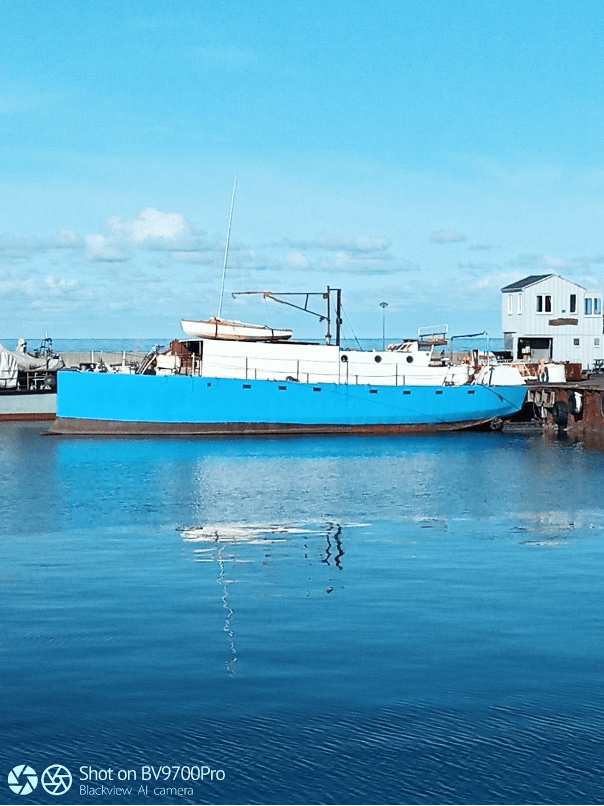
Lo Entropy, 2024

Peter Roberts

Peter met with EAR on February 29, 2024, to tell us about his work and its place in the future of green building. Peter has two web pages, and some wonderful videos have been made about his work. He recently completed his model masonry house, which is now available to rent through VRBO and Airbnb.  Peter also holds several patents.

Peter Roberts’ house in Alfred, New York

He gave a fascinating overview of what he sees as problems and possible solutions to the considerable amount of carbon produced by the construction industry. He told us that cement is one of the most commonly used materials on earth. Second only to water. The construction industry, which amounts to about four trillion dollars worldwide, is conservative and slow to change. However, there are new ways of making cement, using materials other than the traditional limestone and clay that are mined, ground to a fine powder, and then heated at very high temperatures. Peter explained many of the new techniques, including using volcanic material as the ancient Romans did to make constructions that are still standing after two thousand years. I confess that until I listened to Peter, I didn’t know that cement and concrete were two different things, even though we often use them interchangeably in everyday language. Cement is the binding ingredient that is essential in making concrete. There is much information available on all of this. A good starting place might be:

https://www.greenbiz.com/article/cement-most-destructive-material-world-or-driver-progress.

Conclusion

Learning about the work of Geoff Boerne and Peter Roberts gives me hope for a more sustainable future for our planet.  Please contact either of them if you would like more information or are interested in helping with their endeavors. Perhaps one day we’ll have zero carbon emission and create concrete boats propelled by wind and hydrogen?

Contacts:

Geoff Boerne: website https://www.greenseatransport.com/ or his email address, Loentropy@gmail.com) 

Peter Roberts: https://www.masonryarches.com/ or his email address, roberts.peter01@gmail.com

18) Thomas Hübl, Attuned: Practicing Interdependence to Heal Our Trauma—and Our World, pub 2023 (read Feb-Mar 2024)

17) Deb Chachra: How Infrastructure Works: Inside the Systems That Shape Our World, pub 2023 (read Jan 2024)

16) Edward Struzik, Swamplands: Tundra Beavers, Quaking Bogs, and the Improbable World of Peat, pub 2021 (read Oct 2023)

15) Joy Harjo, Poet Warrior: A Memoir(poet laureate) read ???

14) Sarah Augustine, The Land Is Not Empty, pub 2021 (read Jun 2023)

13) Amitav Ghosh, The Nutmeg’s Curse, pub 2022 (read Mar 2023)

12) E.F. Schumaker, Small Is Beautiful, pub 1973 (read Dec 2022)

11) Vanessa Machado de Oliveira, Hospicing Modernity: Facing Humanity’s Wrongs and the Implications for Social Activism, pub 2021 (read Oct 22)

10) Imbolo Mbue, How Beautiful We Were, pub 2021 (read Aug 2022)

9) Robin Wall Kimmerer, Braiding Sweetgrass,pub 2013 (June 2022)

8) Kristen Olsen, The Soil Will Save Us, pub 2014 (read Apr/May 2022) 

7) Paul Hawken, Regeneration: Ending the Climate Crisis in One Generation,pub 2021 (read Feb/Mar 2022)

6) Lydia Millet, A Children’s Bible, pub 2020—a novel (read Jan 2022)

5) asknature.org website —created by Janine Benyus, Biomimicry Institute (studied Oct 2021)

4) Kate Haworth, Doughnut Economics: Seven Ways to Think Like a 21st Century Economist, pub 2017 (read Jul/Aug 2021)

3) Arlie Hochschild, Strangers in Their Own Land: Anger and Mourning on the American Right, pub 2016 (read June 2021)

2) Shalanda H. Baker’s Revolutionary Power: An Activist’s Guide to the Energy Transition,pub 2021 (read Mar-Apr 2021)

1) Ayana Elizabeth Johnson and Katharine K Wilkerson (eds), All We Can Save: Truth, Courage, and Solutions for the Climate Crisis, pub 2020 (read Jan 2021)

Also, we’ve reviewed some articles and digital resources, including:

Jeremy Lent—Patterns of Meaning (Mar 2022) blog piece on climate change and capitalism NMHealthySoil.org
New York Times article on chicken
Kiss the Ground (video)

https://www.nytimes.com/2024/03/28/climate/a-first-step-toward-a-global-price-on-carbon.html?ugrp=u&unlocked_article_code=1.hE0.DJCu.rKomxiheliAm&smid=url-sharemProposal of a tax on carbon emissions for shipping by the International Maritime Organization.

https://www.imo.org/en/MediaCentre/PressBriefings/pages/IMO-agrees-possible-outline-for-net-zero-framework.aspx