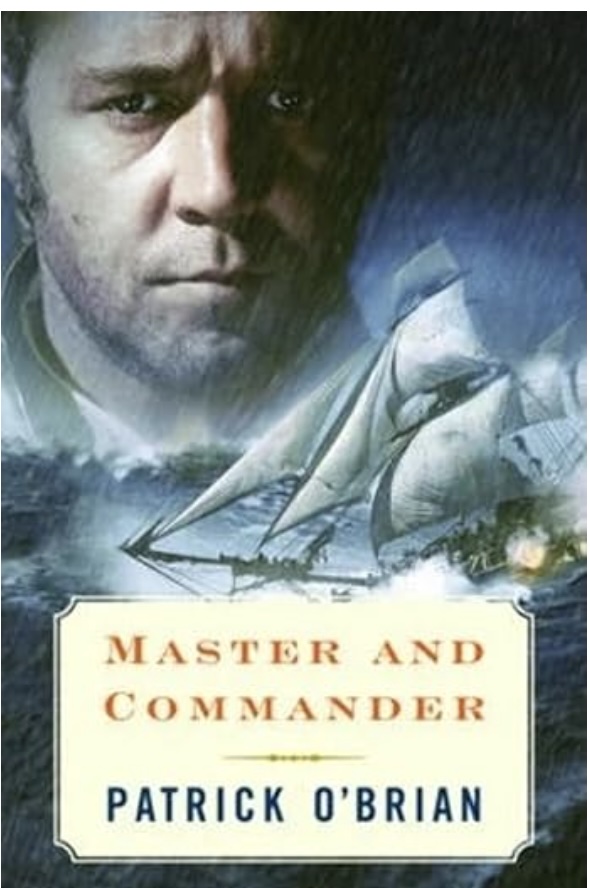
A few days ago, I stuck my nose in our Little Library and discovered a collection of 10 Patrick O’Brian Aubrey/Maturin novels. I hadn’t read any of these books since leaving Coot twenty-five years ago. The three or four books I read in the 1980s and 90s were acquired haphazardly in trades with other boaters and read without order or coherence. I set the stack of books beside my chair, took a look at the top one, started reading, and finished it the next morning. I arranged the books in order, starting with Master and Commander, and I am now on the fifth one.
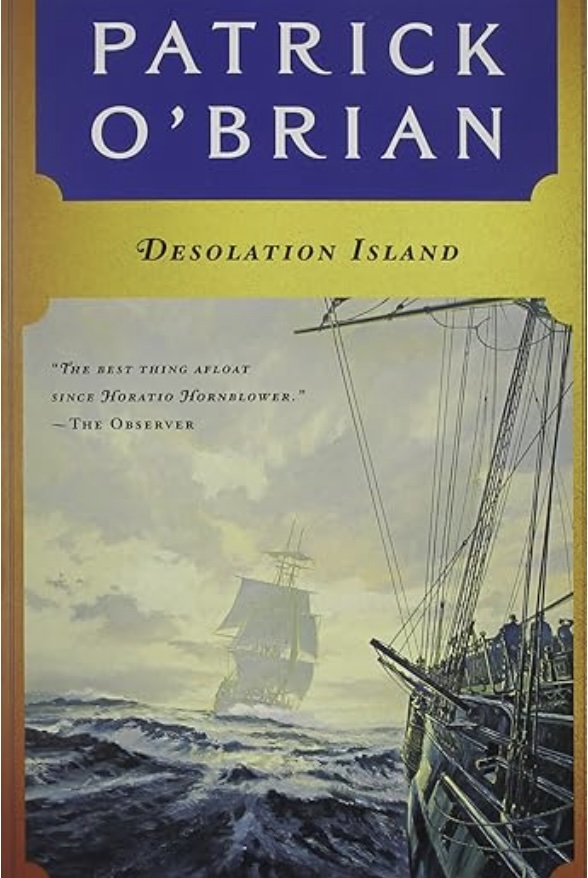
I delight in the sailing descriptions. O’Brian manages to bring the life and times of the British Navy in the 18th century to life better than any other author I know. I just finished reading his account of a stormy crossing of Biscay Bay in Desolation Island, and it rang true to my own 1984 experience of that body of water. Despite the difference between a 74-gun ship of the line and a 38-foot ketch, extensive repairs were required in both cases.
More from Jim Sollars
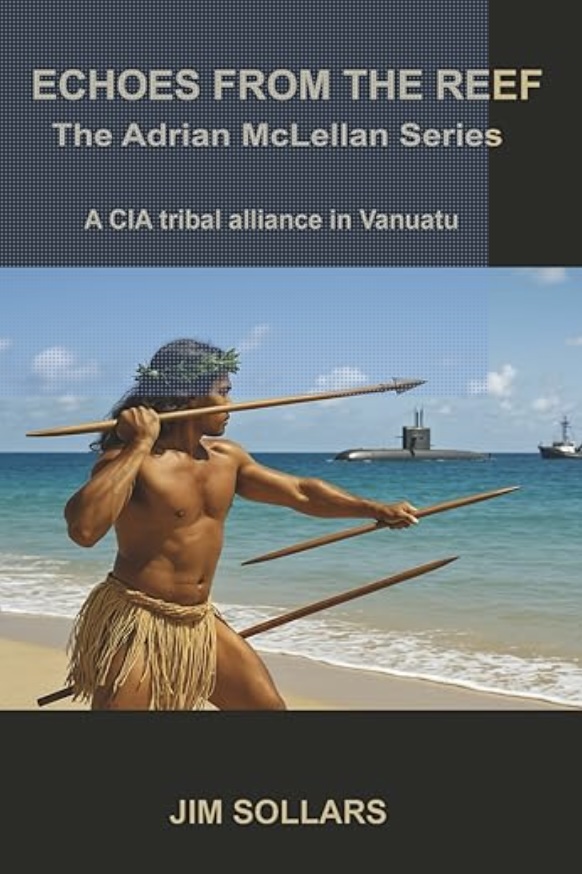
Like Kent, Jim is from Sheridan, Wyoming, and became a sailor and a writer. Unlike Kent, Jim is prolific, with books published on Amazon in both October and November this year. Here is his latest thriller:
Friends from the Past
We are following the adventures of Ned and Kate Phillips on Instagram, the same Ned and Kate Pam and Kent met more than thirty years ago in the Chesapeake (October 1994). (See Chapter 11, Going South, pp. 109-11.) They are now sailing from England to the Cape Verde Islands and beyond. Coincidently, if all goes to plan, Kent and Linnea will arrive via the ninety-eight-passenger Corinthian at Santiago Island in the Cape Verde Islands on Christmas morning (one month from today), but we will almost certainly miss Ned and Kate.
Kate at the Helm
Happy Thanksgiving to one and all!
“Hang on to your hat. Hang on to your hope. And wind the clock, for tomorrow is another day.”
—E.B. White, author
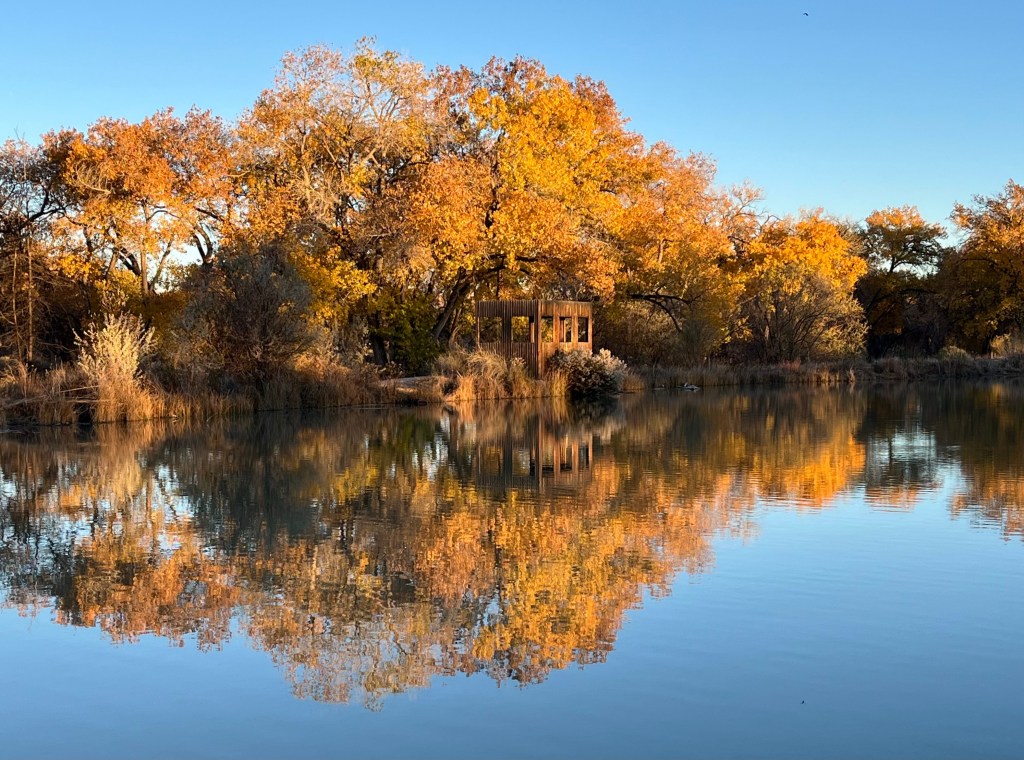
Reflection, Tingley Pond, Albuquerque Bosque, November 24, 2025
l-r: Jake, Pam, Andy, Kent on trial sail on Lake Superior in 1984, just before they left for England
In 1984, fed up with teaching philosophy to disinterested students, unhappy with American consumerism and politics, and dismayed at the values his children were picking up at school and from their friends, Kent and his wife Pam abandoned their comfortable life in a South Dakota college town for life on a sailboat with their two children. Life would never be the same again, as this father seeking a better life for his family made a bold decision that would change the lives of all of them forever. Happy Father’s Day, Kent!
Read all about in We Ran Away to Sea: A Memoir and Letters, available through your local bookstore (try Bookshop.org), Amazon and Barnes and Noble. Now also available as an audiobook.
Two Pilgrims: Linnea and Kent taking a break along the roadside.
We haven’t been doing much with Jacana Press and We Ran Away to Sea in the weeks since the audiobook was published. This is because we’ve been walking with backpacks on the pilgrim route Le Chemin de Vézelay, one of the four original pilgrimage routes through France to St. Jacques de Compostelle (also known as Santiago de Compostela) in Spain.
We walked for about 3 weeks, the amount of time we allotted. We carried a few bookmarks and one copy of the book, thinking we’d take advantage of photo ops, but, in truth, we forgot, except for one lovely morning along a waterway. You can follow our adventures on the blog posts that begin here on Caminobleu.com.
Meanwhile, book sales have picked up. I’m not sure if it’s the revised book description or if more people are looking to run away.
Below: Kent after reading a passage from We Ran Away to Sea near the conjunction of the Allier and the Loire, in Burgundy, France. I’m not able to upload the video, but you can view it on TikTok.
Amazon notified us last week that We Ran Away to Sea was eligible to participate in the beta digital voice program to create an audiobook. We’d wanted to do an audiobook forever, preferably in two voices, to mirror Pam and Kent’s parts of the book.
We picked out male and female American accented voices we liked, followed the directions, and voilá, like magic, with a pause of only fifteen seconds, the chosen voice read the Prologue with scarcely a hitch, not sounding at all like a computer-generated voice. I’m thinking of Hal from Space Odyssey 2001, which is from the last century. You can tell how old we are!
How we did it
Kent spent most of the weekend, when we weren’t at the Hands Off Rally at Albuquerque’s Civic Plaza, “reading” or perhaps “listening” to the book, chapter by chapter, and correcting pronunciation errors. We had special difficulties with the Spanish place names such as Málaga, Mérida, and Carasí, as well as the pronunciation of wind and wind — as in “blowing wind” and “wind up”. It was rather jarring to hear the title Wind in the Willows as “wined in the willows.”
We learned that although we could change male and female voices chapter by chapter, there was no way to change the voices in mid-chapter. So, Kent decided to have the entire book read in a male voice. We had to give up my original dream of having an interplay of male and female voices, representing Kent and Pam. We were able to use the pronunciation correction tab to insert the name of the person speaking by replacing the beginning words of a paragraph and including the speaker’s name in places where the switch in speakers could be confusing. In the printed version, we had initially considered prefacing each change in voice by inserting the person’s name, e.g., Kent: Bla-bla-bla or Pam: Bla-bla-bla, but in the end, we chose to indent the sections in which Pam is writing (speaking) to differentiate the two voices.
Strengths and Weaknesses
(1) It is amazing the way the digital voice picks up inflections and pronounces most words flawlessly, even ones I would have to think about or look up before saying them aloud. We did. have difficulty correcting pronunciations of Spanish place names, which were not pronounced consistently. A blind reader commented that the digital voice readings were much better than the usual text to speech applications generally available. I am sorry our blind friend Craig did not live to listen to our book.
(2) Although we initially hoped to narrate the book ourselves, we weren’t sure our voices would be good enough and the reading and editing would have taken an estimated 40 to 50 hours. Paying someone to do this would cost several thousand dollars.
(3) We found typos and mistakes that we had not previously noticed, even though we had read aloud to each other as we were editing. Good!
(4) We found the book surprisingly pleasant to listen to. Hey, it’s a good story!
(5) We were not able to eliminate things like names of the maps, and all the back matter, such as a timeline, glossary, and bibliography. Listeners will have to fast-forward or skip through these. It would be nice to have more flexibility in eliminating sections.
(6) The audiobook is only available through Audible, not accessible through libraries or other listening systems.
(7) In writing future books I will be more aware of formatting decisions that will impact an audiobook format.
We’d love your feedback, and we hope that Amazon will make some improvements, such as allowing switching voices within chapters and making the pronunciation of Spanish placenames more consistent. If you purchase the Kindle book from Amazon for $6.99, you can add the audiobook for only $1.99 more. If you want to buy the audiobook as a stand-alone, the cost is $7.99.
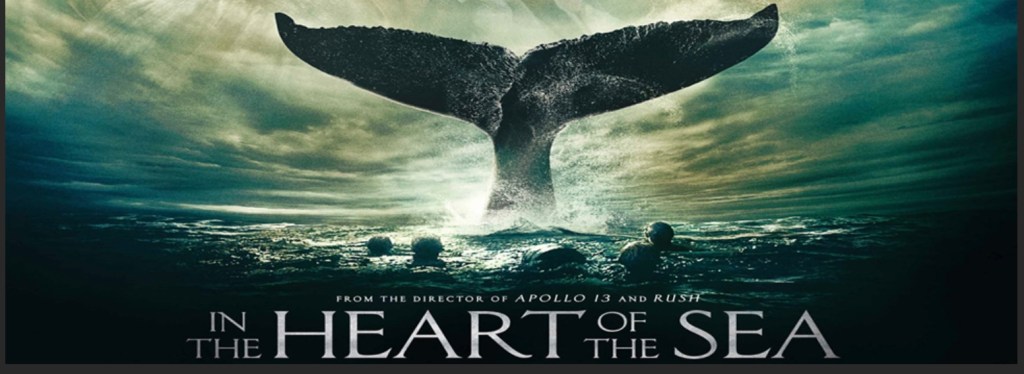
I recently watched In the Heart of the Sea, a 2015 movie directed by Ron Howard and based on Nathaniel Philbrick’s book of the same name, which tells the story of the whaling ship Essex, stoved in by a white whale and sunk in the Pacific in 1820. This story inspired Melville’s Moby Dick.
One scene in the movie resonated with me.
After the whale sinks the ship and wreaks havoc upon its crew, he later emerges from the depths and lies alongside a small boat of desperate survivors. Chase, the lead character in the story, an ambitious, dedicated whaler, grabs a harpoon and stands ready to thrust it into the whale: Chase’s eyes and the whale’s eye lock. Chase hesitates. The captain urges him to thrust the harpoon. Chase continues to hesitate, still holding the harpoon, eye to eye with the whale, and watches, transfixed, as the whale sinks into the deep and swims away to its own uncertain future, leaving the destitute whalers to survive as best they can.
In 1984, I gave up my profession, home, possessions, and the only life I’d ever known. With only a dream and the money freed by selling up, I took my family and set out to create a life at sea. Our first sail was across the Atlantic from England (where we found our boat) to the Caribbean. Between learning to sail and navigate, modifying and repairing the boat to make it deep-sea-ready, and trying to keep my reluctant family together, I had little time or energy to learn much about the creatures of the sea.
Halfway across the ocean, we were becalmed in an endless, flat sea. A swordfish as long as our 38’ boat surfaced next to us. It rolled on its side to study us with one large, round eye staring directly at us. It did not seem threatening or menacing, but what did I know? I had no harpoon at the ready. I was not afraid. Nor was I angry or seeking revenge like Chase. I watched, as after several minutes it sank quietly back into the deep.
A deep emotion welled up within me. When I stared into that eye, I was humbled, even ashamed, to have invaded the fish’s home in such ignorance. We humans confront nature with such arrogance!
Unlike Melville’s Captain Ahab, Chase gave up whaling and became an independent ship captain in the Merchant Marine. Perhaps, while staring into the whale’s eye, he also came to acknowledge his shameful disrespect for the natural world and its creatures.
Wild creatures’ eyes can penetrate deeply into the soul. Think of Aldo Leopold’s famous, life-changing story of watching the eyes of the dying wolf that he had just shot. “I realized then, and have known ever since, that there was something new to me in those eyes – something known only to her and the mountain.” (A Sand County Almanac). — G. Kent Kedl
A Memory, Moby-Dick, and a Song
After seeing the film In the Heart of the Sea and recalling Kent’s encounter with the swordfish, I remembered my first reading of Moby-Dick.
I was living in New York City and taking a class in American Literature with Nick Lyons at Hunter College. Do you know that sometimes the book title is written Moby Dick and sometimes hyphenated Moby-Dick? An internet search turns up intense discussions on this burning issue. Lyons, who later became a publisher known for his writings on trout fishing, preferred the hyphenated title.
While some people think Melvillle’s detailed descriptions of the natural history of whales interrupt the flow of the story, they were some of my favorite parts of the book. They sparked what has become a lifelong love of whales and other wonders of the seas.
During those years, I had a friend I hoped would be my boyfriend — something that never quite happened, an experience that haunted me until he found me again some fifty years and two husbands later, but that’s another story.
Bobby’s occasional, usually unannounced, visits would last for hours. We often took long walks through lower Manhattan from my apartment on East 7th Street, sometimes to the West Village to places he knew had been lived in or frequented by Dylan Thomas, Edna St. Vincent Millay, e.e. cummings, and others, or to the Staten Island Ferry, where we rode back and forth as many times as we wanted for ten cents. We recited the refrain of Edna St. Vincent Millay’s “Recuerdo” to each other and pretended to search for whales.
“We were very tired, we were very merry—
We had gone back and forth all night on the ferry.”
Bobby not only shared my love of literature and long, rambling walks, he was a poet who wrote songs and played the guitar. In those pre-internet days, we riffled through my collection of songbooks to find songs that one or the other of us knew. It was Bobby who taught me “Spanish Is the Lovin’ Tongue.” He also introduced me to the writings of Henry Miller and Anaïs Nin.
Our discussions of Moby-Dick inspired me to write a song. I was pleased that Bobby admired the Dick, flick, and trick lines. We sang it together.
Now and then, I sing snatches of the song to myself.
But, the other day, I could remember only two stanzas and the chorus. A little later, another couple of lines pushed into my brain. Was there more?
Surely, I’d saved a written copy? But where? I found two files labeled poetry in one file drawer and a loose-leaf notebook labeled “I am Eating Poetry” (from a poem by Mark Strand) that I had used when teaching, but they contained no poems I had written.
A search of the garage uncovered dusty boxes containing many files of treasures and many that should be thrown away. But, a folder labeled, “Poems – Mine!” delivered on the top of the pages a poem beginning, “Oh that stormy old weather…” and seven stanzas, four of which I’d entirely forgotten. Memorable or not, they form a much condensed musical version of Moby-Dick.
That Stormy Old Weather
A much condensed musical version of Moby-Dick.  See also the video with me singing on YouTube.

Chorus:

Oh, that stormy old weather
That windy old weather
When the wind blows, boys
We’ll all go together.

A fellow named Ishmael
Related a wild tale
Of how he went sailing
In search of a white whale.

Perched high on the mast
With the sea floating past
Ishmael had his visions
And dreams he held fast.

While Queequeg was often
At work on his coffin
Men knew by the sea-signs
When whales were in the offin’.

Then up jumped old Ahab,
Old peg-legged Ahab
And said, “There she blows, boys!”
“We’ll all go together.

“Look out for Moby-Dick
He’s up to any trick
We’ll all go down under
When he gives his tail a flick.”

Entrapped in those great jaws
No time to think or pause
Were they the victims of
Fate or Divine laws?

Ishmael alone
Did not sink like a stone,
He clung to the coffin
That Queequeg had known.

Chorus (repeat)

-- Linnea Hendrickson
Do You Know These Facts about Whales?
Male Sperm Whales turn white as they age. The whiter the whale, the older it is. Moby Dick is not a myth.
Sperm whales sleep in a vertical position in the water. Unlike humans, they need to be awake to breathe, so while one-half of the brain sleeps, the other half remains alert, allowing them to breathe and watch for predators.
Depending on their pitch, whale sounds can travel 6000 to 10000 km underwater. Noise from the engines of boats and ships disturbs their communication patterns.
Whales can dive to a depth of 1 to 2,000 meters (more than half a mile to more than a mile deep) and can stay underwater without breathing for an hour or more, depending on the species.
Whales and dolphins are mammals who nurse their young and have complex family and social systems. Their closeness is one reason that when one whale is beached, others follow, even to their deaths.
The great blue whale is the largest animal that has ever lived. Commercial whaling has been banned worldwide since 1986, except for Norway, Iceland, and Indigenous people. Still, many whales are killed by encounters with ships, and some killings are justified as “scientific.”
For more information on all forms of sea life, see Oceana.org For an excellent 50-minute video about one man’s intense fascination with Sperm Whales, see the PBS nature film Patrick and the Whale.







 Jacana Press