Former philosophy professor George Kent Kedl gave up his 20-year teaching career for life on a sailboat with his wife and children. His award-winning release We Ran Away to Sea: A Memoir and Letters (2023) was written with a combination of his late wife Pamela Thompson Kedl’s letters and his own memories of their adventures. Look for Kent on his website JacanaPress.com, on Facebook and on Tiktok. We Ran Away to Sea is available at Amazon, Barnes & Noble, and Bookshop.
At its heart, what is your memoir about? It is the story of my mid-life crisis, roughly spanning from 1984 to 2000, when I was obsessed with creating a life of cruising the world on a sailboat.
A mysterious heavy padded envelope arrived in the mail. What could it be?
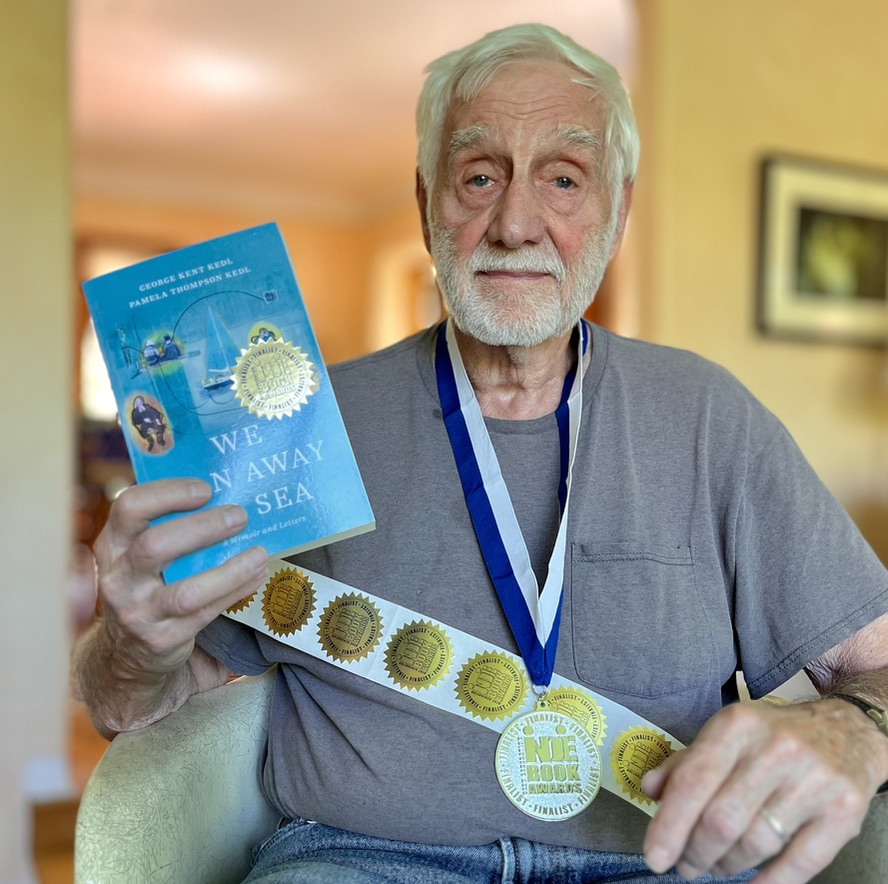
“I think I won an award!” Kent said.
Sure enough. We unwrapped the package and inside was a heavy silver medal with a blue ribbon, a booklet listing all the 2025 Next Generation Indie Book Awards, and a sheet of stickers. It turns out We Ran Away to Sea was a FINALIST in the memoir category. This was not a high enough ranking to earn him an invitation to the awards ceremony that was held in conjunction with the American Library Association annual meeting in Philadelphia (wouldn’t that have been fun?), but we were pleased nevertheless.
We are done with entering book awards, although, I suppose we could consider entering a contest for an AI generated audio book, if there is such a thing.
We received nice review of the audio book (available through Amazon Audible) shortly after the audio book was published. We don’t know who CHS is, but thank you!
As soon as the audiobook was available, I purchased it. Enjoyed going on this adventure with the authors. I learned sailing can be a lot of work. I was very impressed with AI narrator. — CHS
Reviewed in the United States on April 29, 2025
Impromptu video from France
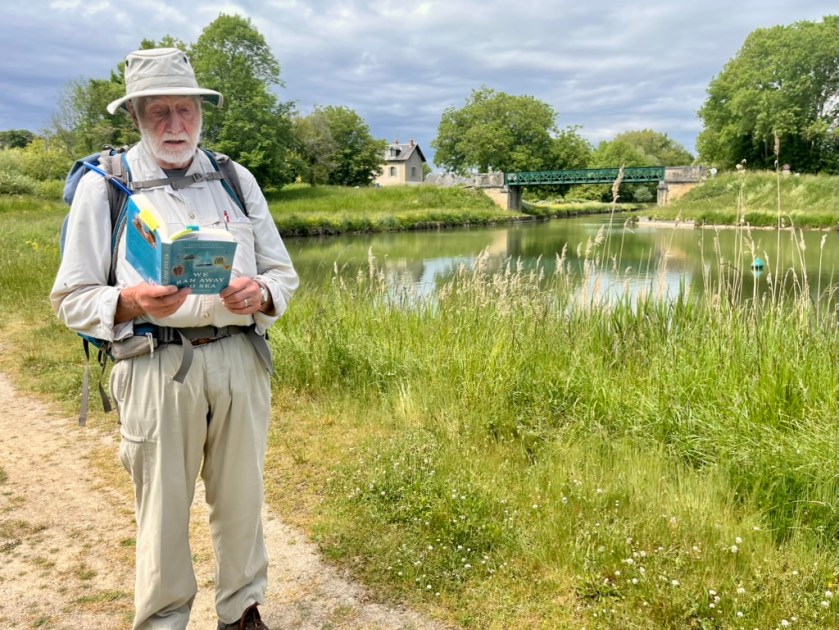
We carried a copy of We Ran Away to Sea during our walk in France, but seldom remembered to take it out of Kent’s backpack. But one day as we walked along a canal, we did. The video is on TikTok.
l-r: Jake, Pam, Andy, Kent on trial sail on Lake Superior in 1984, just before they left for England
In 1984, fed up with teaching philosophy to disinterested students, unhappy with American consumerism and politics, and dismayed at the values his children were picking up at school and from their friends, Kent and his wife Pam abandoned their comfortable life in a South Dakota college town for life on a sailboat with their two children. Life would never be the same again, as this father seeking a better life for his family made a bold decision that would change the lives of all of them forever. Happy Father’s Day, Kent!
Read all about in We Ran Away to Sea: A Memoir and Letters, available through your local bookstore (try Bookshop.org), Amazon and Barnes and Noble. Now also available as an audiobook.
Two Pilgrims: Linnea and Kent taking a break along the roadside.
We haven’t been doing much with Jacana Press and We Ran Away to Sea in the weeks since the audiobook was published. This is because we’ve been walking with backpacks on the pilgrim route Le Chemin de Vézelay, one of the four original pilgrimage routes through France to St. Jacques de Compostelle (also known as Santiago de Compostela) in Spain.
We walked for about 3 weeks, the amount of time we allotted. We carried a few bookmarks and one copy of the book, thinking we’d take advantage of photo ops, but, in truth, we forgot, except for one lovely morning along a waterway. You can follow our adventures on the blog posts that begin here on Caminobleu.com.
Meanwhile, book sales have picked up. I’m not sure if it’s the revised book description or if more people are looking to run away.
Below: Kent after reading a passage from We Ran Away to Sea near the conjunction of the Allier and the Loire, in Burgundy, France. I’m not able to upload the video, but you can view it on TikTok.
Amazon notified us last week that We Ran Away to Sea was eligible to participate in the beta digital voice program to create an audiobook. We’d wanted to do an audiobook forever, preferably in two voices, to mirror Pam and Kent’s parts of the book.
We picked out male and female American accented voices we liked, followed the directions, and voilá, like magic, with a pause of only fifteen seconds, the chosen voice read the Prologue with scarcely a hitch, not sounding at all like a computer-generated voice. I’m thinking of Hal from Space Odyssey 2001, which is from the last century. You can tell how old we are!
How we did it
Kent spent most of the weekend, when we weren’t at the Hands Off Rally at Albuquerque’s Civic Plaza, “reading” or perhaps “listening” to the book, chapter by chapter, and correcting pronunciation errors. We had special difficulties with the Spanish place names such as Málaga, Mérida, and Carasí, as well as the pronunciation of wind and wind — as in “blowing wind” and “wind up”. It was rather jarring to hear the title Wind in the Willows as “wined in the willows.”
We learned that although we could change male and female voices chapter by chapter, there was no way to change the voices in mid-chapter. So, Kent decided to have the entire book read in a male voice. We had to give up my original dream of having an interplay of male and female voices, representing Kent and Pam. We were able to use the pronunciation correction tab to insert the name of the person speaking by replacing the beginning words of a paragraph and including the speaker’s name in places where the switch in speakers could be confusing. In the printed version, we had initially considered prefacing each change in voice by inserting the person’s name, e.g., Kent: Bla-bla-bla or Pam: Bla-bla-bla, but in the end, we chose to indent the sections in which Pam is writing (speaking) to differentiate the two voices.
Strengths and Weaknesses
(1) It is amazing the way the digital voice picks up inflections and pronounces most words flawlessly, even ones I would have to think about or look up before saying them aloud. We did. have difficulty correcting pronunciations of Spanish place names, which were not pronounced consistently. A blind reader commented that the digital voice readings were much better than the usual text to speech applications generally available. I am sorry our blind friend Craig did not live to listen to our book.
(2) Although we initially hoped to narrate the book ourselves, we weren’t sure our voices would be good enough and the reading and editing would have taken an estimated 40 to 50 hours. Paying someone to do this would cost several thousand dollars.
(3) We found typos and mistakes that we had not previously noticed, even though we had read aloud to each other as we were editing. Good!
(4) We found the book surprisingly pleasant to listen to. Hey, it’s a good story!
(5) We were not able to eliminate things like names of the maps, and all the back matter, such as a timeline, glossary, and bibliography. Listeners will have to fast-forward or skip through these. It would be nice to have more flexibility in eliminating sections.
(6) The audiobook is only available through Audible, not accessible through libraries or other listening systems.
(7) In writing future books I will be more aware of formatting decisions that will impact an audiobook format.
We’d love your feedback, and we hope that Amazon will make some improvements, such as allowing switching voices within chapters and making the pronunciation of Spanish placenames more consistent. If you purchase the Kindle book from Amazon for $6.99, you can add the audiobook for only $1.99 more. If you want to buy the audiobook as a stand-alone, the cost is $7.99.
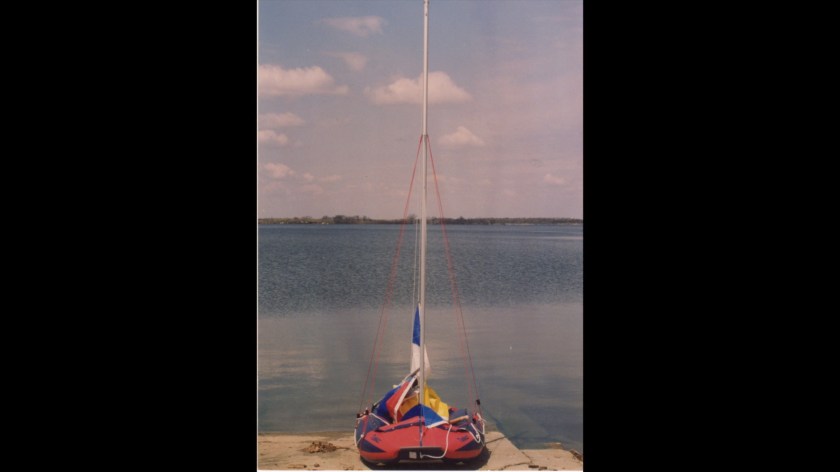
One of my favorite passages of Pam’s writing is the “The Dinghy Under the Bed.” Unlike her letters which were sometimes hastily written on a rocking boat, this was a polished piece, probably intended for publication. It is now included in Part 2: Between the Boats.
After listing the sailing paraphernalia stored in their South Dakota guest room closet Pam describes the inflatable dinghy that lives under the bed and is their most important purchase next to the “mother ship.”
My startled guests tell me it looks like the pale, flabby remains of some unidentifiable monster.
Although many readers feel that Pam reluctantly went along with Kent’s dream of returning to a life at sea, this passage expresses her longing, too. She was writing on a cold rainy day in October, not so different from early March, when winter seems to drag on forever, and we long to cast off on a new adventure as spring approaches.
After the mother ship herself, the dinghy, a lovely new roll-up, is our largest purchase and represents much more than a dollar value. Our future home, a 31-foot steel sloop pulled ignominiously out of the water in Duluth, Minnesota, is wrapped now in her winter cover. It would be a long seven-hour drive through uncertain midwestern weather to assure ourselves that our dream has some substance. But the dinghy is here, living quietly like a friendly, elderly dog beneath the bed. I sometimes think I can hear it sigh a little wistfully, just as I do, for the time we’ll both be at sea.
* * *
It’s a long and frustrating process to move from a landlocked South Dakota job and home to the sea. It’s also a lonely process, for none of our friends share or even understand our dream. But the dinghy, peacefully resting beneath the bed, silently encourages us to keep dreaming.
All those New Year resolutions and good intentions!
Walks: We led members of the Albuquerque Chapter of American Pilgrims on the Camino on a trek along the Rio Grande Bosque on New Year’s Day.
Reading: First, not exactly reading, we indulged in Netflix’s gripping One Hundred Years of Solitude, based on Gabriel Garcia Marquez’s novel.
Our reading has included books by three New Mexico authors, starting with Hampton Sides’ fascinating and much honored The Wide Wide Sea centered on the third and final journey of Captain Cook. I am impressed with the way Sides holds the readers’ interest by telling a complex story through short passages and vignettes without overwhelming us with his research.
We’ve also read Rebecca Reynolds’s Thresholds of Change, which we will share with our little EAR (Elder Activist Readers) book group, and we have enjoyed our friend Rosalie Rayburn’s third book in her Digger Doyle Mystery series: Windswept, set in beautifully depicted New Mexico landscapes.
Writing: Kent is writing and expanding on more stories, some left out of We Ran Away to Sea, and some new ones. Here is the beginning of one:
A Shortcut and a Close Shave
Shortcuts can save time and effort, but sometimes there are unexpected complications.
Sailing to the Atlantic side of Florida from Ft. Myers on the Gulf Coast requires a long trip, but…
Shortly after we learned that We Ran Away to Sea was a finalist for the Global Book Awards, we received notification that the book had won a Silver Medal in the category of Biography/Memoir. There are still more award announcements awaiting in the next few months. I expressed my reservations about awards, still it is nice to be noticed and to learn that someone (beisdes our friends and family) thinks highly of the book.
Shortcuts can save time and effort, but sometimes there are unexpected complications.
Sailing to the Atlantic side of Florida from Ft. Myers on the Gulf Coast requires a long trip south to the Florida Keys, then east and north around Miami, but if a boat is small enough there is a shortcut via the Okeechobee Waterway that runs between Ft. Myers and St. Lucie. The limitation is that mast of the boat has to fit under a railway lift bridge that crosses the waterway.
Coot’s mast was short enough to fit under the open bridge, but with little room to spare. We approached the open un-attended bridge with a strong current in the narrow channel pushing us forward. Just before we were going to pass under it, suddenly, without warning, horns blared, lights flashed and instantly the bridge began to descend.
Too late to stop or turn around, I hit the throttle, envisioning our mast caught between the rails and shaved off by the oncoming train like a whisker in a Norelco razor. We made it with inches to spare—I heard the ting, ting, ting of the masthead antenna as it scraped beneath the descending bridge.
We were heading home, and although we didn’t know it then, this would be one of our last narrow escapes on Coot.
Kent and I are enjoying a lovely, quiet Christmas at home, but we have made “Hilma’s Holiday Glögg,” spelled Glug (but pronounced gloog) on the recipe card typed by Evelyn Easley, mother of my friend Linda, probably 60 years ago. No one seemed to know who Hilma was, but the aroma of raisins, cinnamon, sugar, and cardamon seeds heating, before they are added to a gallon(!) of Burgundy wine brings back years of holiday memories. In the 1950s and 60s, drinking alcohol wasn’t common among our relatives and friends. Evelyn was a bit conspiratorial as she introduced me to this drink, which she served hot in a teacup with a dollop of brandy as we visited in her kitchen one Christmas when I was home visiting. I’m sure after the cycle of heating and re-heating, the alcohol remaining in the original gallon is minimal, but it seemed a bit daring at the time and a new experience to be treated as an adult by my childhood friend’s mother.
So, here’s a gift of Hilma’s Holiday Glug recipe! Enjoy!
Book News
We Ran Away to Sea received two unexpected honors this month. The book received first place in the Royal Dragonfly Book Award in the Letters, Journals, and Diaries category. When I saw that category for this award, I thought it would be a good one to apply for because the number of entries would be smaller than for the category memoir. And I was right! The book is also a finalist in the Global Book Award memoir category. We’ll find out in a few days if the book is one of the winners.
I’m a bit skeptical of book awards, even though I researched to avoid those that are solely money-making scams, but it is nice to be recognized. Thanks to all of you who have bought the book, especially those who have written reviews.
Kent also gave a presentation to the Sandia Civitan Club. This lovely small group meets for breakfast every Friday and does tremendous volunteer work to benefit people with disabilities. It was a pleasure to meet them and learn about the work they do.
Kent’s been writing something for the past several days that I haven’t yet seen. I wonder what it is?














 Jacana Press